In This Article
“SSDR” has been renamed to “SDR,” and “System Security Decision Record” is now “Security Decision Record.” Media on this page (images, graphics, or videos) may still show older terminology.
If you’ve been following the shifts in federal compliance of the past year, you’ve probably got questions — and you’re not alone.
Many in GRC are feeling unsure about where FedRAMP is going and the role of AI in GRC.
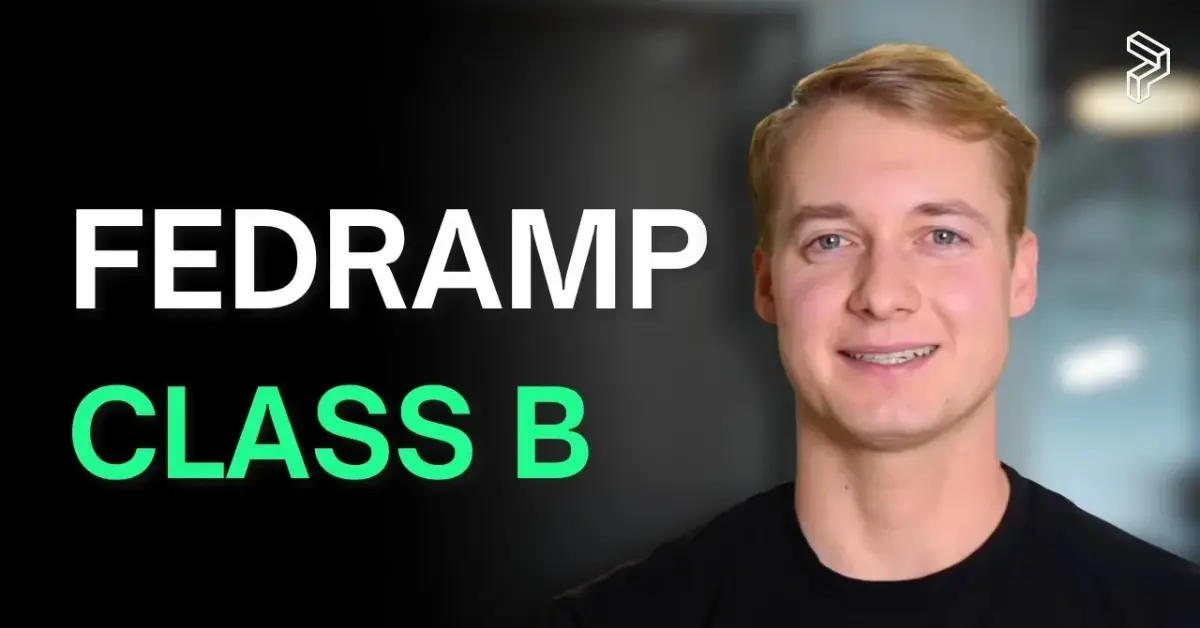
Ethan Troy, GRC engineer, developer, former Army National Guard medic, Coalfire assessor, and now the head of GRC Engineering at TRM Labs, joined our podcast to let us pick his immense brain.
Watch the podcast or read on to find out why he believes FedRAMP 20x is the future and get practical tips for building agents that actually solve real security problems.
Ethan Troy's Path to GRC Engineering
Ethan's background is anything but conventional. He started as a full-stack developer, served as a medic in the Army National Guard, worked at Balmer Shock Trauma in trauma medicine, responded to emergencies at NASA Greenbelt, and was even on track for nursing school before life took a turn.
A chance lunch with a friend working at Ernst & Young changed his trajectory. That friend described IT auditing, and Ethan was like,: that sounds easy.
He earned a Security+ certification, joined Coalfire as an assessor, and quickly rose to leading a team.
Along the way, he built GRC tooling, advised organizations like Blue Cross on replacing legacy platforms, and developed a reputation for shipping products at breakneck speed.
Now at TRM Labs, a blockchain intelligence company helping financial institutions, crypto businesses, and government agencies detect and investigate crypto-related financial crime,
Ethan is now building his own GRC program from the ground up — only three weeks in and it’s already making waves.
Why GRC Is More Than a Paper-Pushing Exercise
GRC deserves more respect than it typically gets.
When people hear "cybersecurity," they think pen testing, red teaming, and threat hunting. Meanwhile, GRC is dismissed as the boring compliance cousin.
But as Ethan and Isaac both point out, GRC brings everything together. You have to understand the code, the compliance frameworks, the legal landscape, and the human dynamics that hold it all together.
To be effective, you need empathy. You have to have the ability to sit between a legal team, an engineering team, and a security team and translate across all three.
Isaac put it well: the reason GRC is interesting is that it sits at the intersection of the deeply technical and the non-technical.
It's where things actually get done.
And with AI adding another layer of complexity, GRC professionals now need to understand a new kind of technology that blurs the lines between people, process, and technology.
The Two Big Problems With Legacy FedRAMP
Kenny didn't mince words about what's broken with the legacy FedRAMP model. He outlined two core issues that have plagued the program for years.
Problem 1: An Agency Cannot Accept Risk for the Entire Federal Government
The legacy FedRAMP model assumed that one agency's authorization could serve as a blanket approval across government.
That's not how risk management works.
Every agency has its own mission, its own threat profile, and its own tolerance for risk. An authorization from one agency doesn't — and shouldn't — mean every other agency can blindly trust the same service.
Agencies need the ability to make their own informed decisions about whether to bring a cloud service into their environment.
Problem 2: The Cost-to-Value Ratio Is Broken
Getting a FedRAMP authorization under the legacy model was extraordinarily expensive.
Organizations would spend months or years producing massive documents, only to have an assessor sit in a room and ask questions that the interviewee answered by reading from the System Security Plan (SSP).
As Ethan described it: assessors would conduct interviews, and the interviewees would literally read the SSP back to them. It's a glorified fact-check against a document that may or may not reflect reality.
That's not adding value to anyone.
The SSP Is Dead — Long Live the SDR
Hot off the press from FedRAMP Director Pete Waterman: the System Security Plan is getting a rebrand. It will now be called the Security Decision Record (SDR).
The name change reflects a fundamental shift in intent.
The SSP was supposed to outline what you decided about your security posture. But instead, it became a narrative exercise disconnected from reality. The SDR reframes the document as what it should have always been: a record of actual security decisions.

As Kenny put it: just because the SSP says you use Splunk to monitor your system doesn't mean that's what's actually happening. FedRAMP 20x is pushing the industry toward evidence-based, machine-readable validation — not 400-page Word documents.
And for those still wondering: Pete Waterman has confirmed that "document" doesn't mean .docx. It never did.
FedRAMP 20x: A Competitive Marketplace for Cloud Security
In the meat aisle, you see the bare minimum, USDA-inspected beef. But you also see local, organic, grass-fed, imported options at every price point. Consumers get to choose based on their budget and their standards.
That's the vision for FedRAMP 20x. Instead of a single, monolithic authorization that tries to be everything to everyone, agencies get a marketplace.
Some agencies need the premium, highest-assurance option. Others just need the basics. Both are valid choices — and both deserve clear, comparable information to make that decision.
This shift has massive implications for competition. Under the legacy model, the federal marketplace was effectively a monopoly for a handful of authorized providers. With 20x, smaller and more innovative services can realistically enter the federal space. This includes orgs like Digital Ocean, niche SaaS platforms, and next-gen security tools.
→ Simplify FedRAMP 20x: Get a video demo of Paramify
The Consulting Industry Must Pivot
If your business model is built on milking the inefficiencies of legacy compliance, you're going to get disrupted.
Ethan is blunt about it: consulting firms that bill by the hour have no incentive to make things faster or better. The structure even rewards complexity. But, FedRAMP 20x flips that model.
If a consultant can get you authorized in less time at higher quality, the question becomes: would you pay a premium for that?
The answer is almost always yes — because faster authorization means faster time to market, faster revenue, and a Security Decision Record that's actually true on an ongoing basis.
The takeaway for consultants and advisors: shift from billing hours to billing outcomes. If you can deliver better results faster, you're much more valuable.
Vulnerability Management in the Age of AI
The conversation turned to the FedRAMP VDR (Vulnerability Detection and Response) standard and why incident response timelines are collapsing.
There was a time when reporting an incident within 12 to 24 hours was the gold standard. That era is over.
The average time to exploitability has shrunk exponentially. Down to less than a day in some scenarios. This is driven by AI capabilities that can identify and weaponize vulnerabilities at machine speed.
For critical systems holding veterans' information or supporting deployed military units, a 12-hour response window is unacceptable.
This is why the new VDR standard focuses on what actually matters: is the vulnerability internet-reachable? Is it likely exploitable? What's the real-world path an attacker would take?
This aligns with Pete Waterman's frequently cited Mission Impossible analogy: nine times out of ten, you don't need to worry about Tom Cruise rappelling through the ceiling. The average threat actor is looking for the easiest way in — cash, data, ransomware. Focus your defenses accordingly.
Defense in Depth Over Single Points of Failure
Isaac drives home a critical security principle: assume breach has already happened.
No matter how good your firewall is — whether it's Palo Alto, Cisco, or AWS WAF — it can't be the only thing standing between your sensitive data and the internet.
The Secure Configuration Guide that FedRAMP has started to implement is a step in the right direction. For many cloud services, the low-hanging fruit is simply configuring things correctly. These cover the 5-10 security levers that prevent the vast majority of common attacks if they’re set up properly.
But the industry still has work to do. Ethan points out that services like GitHub often don't publish the best security configuration guides for their own platforms. It took a company like Wiz to put together a better guide than GitHub did for itself.
GRC Platforms Are Competing Against Spreadsheets
One of the most memorable lines from Ethan: GRC platforms aren't competing against each other - they're competing against spreadsheets.
He's not wrong. When a GRC tool is slower than Excel for bulk updates, when you can't drag a formula across 200 rows, when the interface adds friction instead of removing it - the spreadsheet wins every time.
Paramify's approach has been transparency. The platform's evidence collection scripts are in an open GitHub repository. The logic is deterministic. Auditors can see exactly how evidence was collected, verify the API calls, and trust the output. That's a fundamentally different value proposition than a black-box platform that just shows green checkmarks.
As the industry matures, the real differentiation won't be in basic evidence collection - that's a solved problem. It will be in how platforms create relationships between data points, surface deeper insights, and enable real-time continuous monitoring.
Building AI Agents for GRC That Actually Work
Ethan Troy has become known for building AI agents for GRC workflows. Here’s his practical advice for the rest of us.
Start With Real Problems, Not Cool Tech
Don't automate for the sake of automating. Ethan built tools for the team at his previous role — tools like enhanced CSF (Cybersecurity Framework) control browsers that helped his analysts stop memorizing control IDs and start solving actual problems.
The value wasn't in the tool itself; it was in freeing up cognitive bandwidth for higher-order thinking.
Iterate Fast, Kill Fast
With AI, you can prototype something in hours that used to take weeks. That's a superpower, but only if you're willing to throw away what doesn't work.
Ethan's approach: build it quickly, test it with real users, and don't get attached.
Most of what you build will be garbage. The point is to find the 10% that isn't.
Don't One-Shot Complex Problems
LinkedIn is full of people claiming they replaced Slack or built an entire platform in a weekend with AI. But, that's not reality.
Real platforms are built on integrations, upkeep, edge cases, and years of iteration. AI gives you a faster starting line rather than a finish line.
Domain Expertise Still Matters
Most importantly, the most successful AI agents are roughly 85% deterministic code and 15% AI. The domain knowledge — the understanding of GRC pitfalls, framework nuances, and stakeholder dynamics — is what makes the difference between a demo and a production system.
Someone with deep GRC experience will always outperform a Silicon Valley newcomer who just decides to "build a platform."
Domain expertise combined with AI is a powerful combination.
Key Takeaways
- FedRAMP 20x is creating a competitive marketplace where agencies can make informed risk decisions, not rubber-stamp inherited authorizations.
- The SSP is becoming the SDR (Security Decision Record) — a shift from narrative fiction to documented decisions.
- Consulting must pivot from hours to outcomes. If your business depends on inefficiency, you're already behind.
- Vulnerability response windows are collapsing. AI-driven exploitability means 12-hour response times are no longer acceptable for critical systems.
- GRC platforms must beat the spreadsheet - not just other platforms. Transparency and deterministic evidence collection are table stakes.
- AI agents should solve real problems, not just look impressive on LinkedIn. Start with your team's actual pain points and iterate relentlessly.
- Domain expertise + AI = the winning combination. Neither alone is sufficient.
The Opportunity Ahead
The shift Ethan describes is here, not way off in the distance. The compliance industry is being forced to grow up fast and the organizations that will thrive are the ones that embrace the opportunity.
Paramify was built to help your GRC team make this transition.
While your competitors are still updating 1,800-page SSPs by hand, Paramify automates evidence collection, generates OSCAL-native outputs, and produces ATO packages in 1–7 days — at a fraction of the cost of legacy approaches. The evidence collection scripts are open source. The logic is deterministic. Auditors can verify every API call. No black boxes. No compliance theater.
You need a platform that adapts with the standard, not one you’ll have to rip out in 18 months. Paramify's architecture was designed around First Principles Risk Management: understand the actual security decision, automate the evidence, and skip the narrative fiction.
The best time to modernize was before the standard changed. The second best time is now.
→ Schedule your demo below to see how Paramify can help you adapt to the future of GRC.
Listen to the Full Episode
Catch the full conversation with Ethan Troy on the Paramify Podcast. Want to see how Paramify is helping organizations navigate FedRAMP 20x? Request a demo video or live demo to learn more.

.svg)
.svg)