In This Article

FedRAMP is renaming one of its most-used terms. If you're a CSP, agency sponsor, Independent Assessor, compliance lead, or anyone who deals with FedRAMP at all, it's worth understanding before the change takes effect.
Starting with the Consolidated Rules 2026 (released June 2026, full effect December 2026), "FedRAMP Authorization" becomes "FedRAMP Certification." Ready, Low, Moderate, and High shift to a lettered scale: A, B, C, and D. And the FedRAMP Ready designation is being retired.
Legally, FedRAMP has always certified that a cloud service completed its assessment — only an Agency can authorize a system for use through an ATO. The new terminology finally makes that distinction explicit.
And honestly? Everybody hates change. It's almost supernatural to be scared of it. People want things to stay the same. That's fine to feel, but it's also a little dumb to think things can stay the same — especially with FedRAMP, which needed this fix.
Below: what's changing, what's staying the same, why FedRAMP is doing this, and what it actually means for your workflow.
What's Changing in FedRAMP's Terminology?
Three things are changing in the Consolidated Rules 2026:
- "FedRAMP Authorization" is being replaced with "FedRAMP Certification." Every reference to "FedRAMP Authorized" in official language becomes "FedRAMP Certified."
- The impact tiers are becoming letters. Ready, Low, Moderate, and High become A, B, C, and D, in that order.
Class A is essentially FedRAMP Ready, Class B is FedRAMP Low, Class C is Moderate, and Class D is High.
- FedRAMP Ready is being retired as a standalone designation.
Here's the side-by-side:
| Old Term | New Term |
|---|---|
| FedRAMP Authorization | FedRAMP Certification |
| FedRAMP Ready / Pilot | FedRAMP A |
| FedRAMP Low | FedRAMP B |
| FedRAMP Moderate | FedRAMP C |
| FedRAMP High | FedRAMP D |
That's it. No new control families, no new assessment requirements, no expanded scope. It's a terminology update, not a legal one.
Check out Isaac's video for more details:
Why Is FedRAMP Changing the Terminology?
The legal definition and the way people actually used the word have been out of sync for years, and that gap caused real confusion for both Agencies and CSPs.
The original FedRAMP was, in a lot of ways, dead on arrival. Not because the people behind it didn't try, they did, but because of how it was structured.
A small agency inside the federal government can't realistically accept risk on behalf of every other agency in the federal government. Agencies are required by law to do their own assessment for onboarding vendors. That requirement is based on the RMF, and it doesn't go away just because somebody else stamped a package.
FedRAMP tried to streamline that, and to a real extent it did. But the package deliverables ended up ginormous, hard to understand, and in some places straight-up arbitrary. And it wasn't only the cloud service providers who struggled with that.
Imagine you're an agency trying to figure out where your exposure is, and you have to leaf through a thousand-page document and a giant spreadsheet to figure out which responsibilities are yours.
That's not realistic.
That's why hundreds of agencies have never actually issued an ATO for a FedRAMP product outside of their own internal systems. They don't have tens of millions of dollars to throw at enterprise tooling like the bigger agencies do. The barrier was just too high.
So change was needed. The new terminology — and the broader FedRAMP 20x model it sits inside — is part of that course correction.
What the Law Has Always Said
The legal language behind a "FedRAMP Authorization" was that it "was a certification that a cloud service had completed a FedRAMP authorization process."
Read that twice. Legally, a FedRAMP Authorization has always been a certification — not an authorization.
FedRAMP itself does not have the power to authorize a cloud service for use by a federal agency. It can only certify that a service has completed the assessment process. The actual authorization happens at the Agency level, through an ATO (Authority to Operate).
Why "FedRAMP Authorized" Became Confusing
The original phrasing borrowed agency-level vocabulary to signal that FedRAMP's certifications met the same standards Agencies would apply themselves.
The intent was good. The execution created a misconception.
"FedRAMP Authorized at Moderate" suggested that any Agency using the system also needed to authorize it at Moderate. That's not, and never has been, how it works.
In reality:
- An Agency can authorize a system at a higher impact level than FedRAMP certified it.
- An Agency can authorize a system at a lower impact level than FedRAMP certified it.
- One Agency might authorize a system at Moderate while another authorizes the same system at Low — and the system itself might only be FedRAMP-certified at the Ready equivalent.
And here's the bigger point: if the data your platform hosts is sensitive enough that an agency wants more controls than the certification level requires, they can absolutely add to it. They are issuing the ATO. They can do whatever they need to do to protect their data. The certification is a floor, not a ceiling.
The new terminology reflects what's actually true: FedRAMP certifies. Agencies authorize. Two different actions, two different decisions, two different responsibilities.
Why the Letters?
Switching Ready/Low/Moderate/High to A/B/C/D draws a clear visual line between what FedRAMP issues and what Agencies issue.
Agencies still use Low, Moderate, and High to classify the impact level of their information systems. By moving FedRAMP to a different naming scheme entirely, there's no more accidental one-to-one mapping in anyone's head.
You could be FedRAMP Certified at C and authorized at Moderate by Agency X, and at Low by Agency Y.
The relettering makes that distinction obvious instead of buried.
Is FedRAMP 20x Actually Better?
Worth addressing head-on, because people are nervous about it.
Yes. It is absolutely the better way to do it.
Is it as prescriptive as the old model? No. But you can't be hyper-prescriptive in today's environment with how flexible systems need to be.
And the old prescriptiveness wasn't doing agencies any favors anyway — it was producing thousand-page packages they couldn't realistically use.
A few things worth pointing out about where this is going:
- Real agencies are using Paramify right now because of our FedRAMP 20x authorization. That's not theoretical.
- Some agencies are looking at shifting to the 20x model for their own internal ATOs. That should blow some minds. Agencies adopting the new model for their own systems is the strongest signal that this works when it's set up right.
- 20x is not a free pass. CSPs going through Phase 2 are finding it genuinely rigorous.
We're building the plane while flying it on some pieces, and there are details still being ironed out — but the bar is real. - AI capabilities are letting teams deliver on this faster than they could a few years ago, which matters because the decisions are big and the pace is quick.
Some CSPs hate the change because the old expensive, opaque model created a moat that kept smaller competitors out.
Fair, from their POV. But for the free market and for the government actually getting the best software, removing that moat is a good thing.
It's more accessible for CSPs, and it's way more functional for agencies that need to see what they need to see at a moment's notice.
Is it perfect?
Naw.
But, it's going to keep changing and evolving and getting better.
But it's clearly a step in the right direction, and the terminology update is part of cleaning that up.
What's Not Changing?
Plenty. Here's what stays the same:
- Agencies still use Low, Moderate, and High when authorizing systems for their own use. The Impact Level naming for Agency Authorization is unchanged.
- The control baselines are unchanged. NIST 800-53 controls, the assessment process, the documentation requirements — all the same.
- Continuous Monitoring obligations are unchanged.
- The Independent Assessor assessment process is unchanged.
- Existing FedRAMP packages remain valid. You're not redoing anything.
- The ATO process at the Agency level is unchanged.
In other words: if your team is mid-assessment or maintaining an existing package, none of the work changes. The label on the front of the folder does.
What Does This Mean for You?
Depends on your role.
If you're a CSP pursuing FedRAMP: Update marketing materials, sales collateral, contract language, and customer-facing documentation to reflect "Certification" instead of "Authorization" — and the new lettered tiers. Your internal compliance work doesn't change.
If you're an Agency considering a CSP: You gain explicit flexibility. A FedRAMP-certified system at any level can be authorized at the impact level your data and use case warrant — based on your own risk assessment. The new terminology removes the implicit pressure to mirror FedRAMP's certification level. And if the data is sensitive enough that you want more, you can absolutely add to it. You're issuing the ATO.
If you're a Independent Assessor: Your assessment work is identical. Reporting templates and language will need to be updated when the Consolidated Rules take effect.
If you have a current FedRAMP Ready designation: Plan for the retirement. Talk to your sponsor and your Independent Assessor about how the transition will be handled in your specific package.
If you don't have a sponsor, FedRAMP 20x could be a clear path to full certification. → Quickly transition from FedRAMP Ready to FedRAMP 20x Certified
When Does This Take Effect?
- June 2026: Consolidated Rules 2026 are released. Terminology changes are published.
- December 2026: Rules go into full effect across the program.
That's a six-month runway from publication to enforcement. Use it to update documentation, train your team, and get ahead of customer questions before December.
How to Automate Your FedRAMP Certification Process
Here's the whole vision of Paramify: here's your risk, here are the solutions you use to address that risk, here's how it relates to this control or this KSI, here's how it relates to other KSIs.
And the documentation? That part's taken care of.
We've been in on that joke from the beginning — if you want your document, fine, here's your document. The point is to focus on how you're actually addressing the risk with the capabilities you have, not on hand-assembling a thousand-page artifact.
If your compliance work still lives across a hundred Word documents, the rename is a reasonable moment to rethink the workflow itself. Paramify replaces that sprawl with a single source of truth — generating your SSP, POA&M, and supporting artifacts from structured data, so you can reach FedRAMP Rev 5 certification faster and at a fraction of the cost of traditional, consulting-heavy approaches.
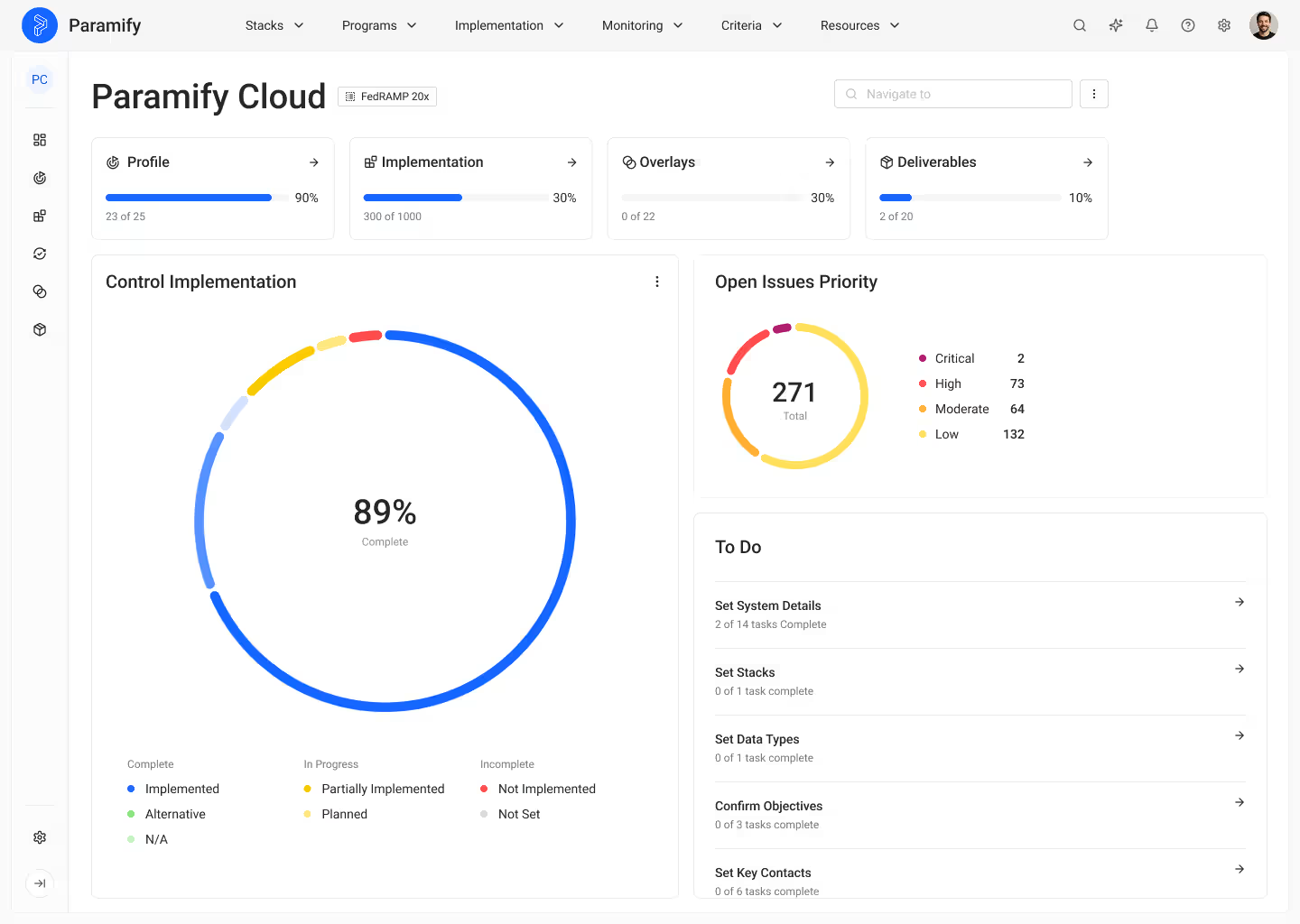
With Paramify, the transition to 20x is simple if you’re already Rev 5 certified or listed as FedRAMP Ready. Paramify maps what you already have to the new requirements, streamlining your FedRAMP 20x process without rebuilding from scratch.
Either way, you spend less time wrangling documents and more time on the security work that actually matters.
→ Watch a video demo of Paramify to see it in action
The Bottom Line
FedRAMP Authorization is becoming FedRAMP Certification. Ready/Low/Moderate/High becomes A/B/C/D. FedRAMP Ready retires. Effective December 2026.
It's a terminology correction, not a compliance overhaul. The legal reality that FedRAMP certifies and Agencies authorize has always been the case. The new naming finally matches it. And it gives Agencies clearer flexibility to authorize systems at the impact level their data and risk tolerance actually require.
Update your documentation. Train your team. And if your compliance work still lives in a hundred Word documents, this is a reasonable moment to ask whether it should.
Have questions about the name change or Paramify? Reach out or schedule a some time with our team to see how Paramify can help you improve your security, meet deadlines, and cut costs.
Frequently Asked Questions
Is FedRAMP Authorization going away completely?
The term "FedRAMP Authorization" is being replaced with "FedRAMP Certification" in official documentation starting June 2026, with full effect December 2026. The underlying program isn't going away — only the name. The legal definition (a certification of completed assessment) stays exactly the same.
What do FedRAMP A, B, C, and D mean?
A, B, C, and D are the new lettered impact tiers replacing Ready, Low, Moderate, and High — in that order. A maps to Ready/Pilot, B to Low, C to Moderate, and D to High. The lettering distinguishes FedRAMP Certification levels from Agency Authorization levels (which keep using Low/Moderate/High).
Does this mean I have to redo my FedRAMP assessment?
No. The change is terminology only. Existing assessments, packages, and ATOs remain valid. There are no new control requirements, no new documentation burdens, and no new submission processes tied to the rename.
Why is FedRAMP Ready being retired?
FedRAMP Ready was an interim designation that, in practice, often blurred the line between "ready for assessment" and "fully certified." Folding it into the new lettered scheme (as A) and retiring the standalone label simplifies the program and reduces ambiguity in marketing claims.
Can an Agency still authorize at a different level than FedRAMP certifies?
Yes — and that's the entire point of the change. Agencies have always had this flexibility because they're the ones taking on the risk and performing the impact analysis based on their data. If the data is sensitive enough to need more, the agency can add to it. The new terminology makes that flexibility explicit instead of implied.
Is FedRAMP 20x actually a free pass compared to the old process?
No. CSPs going through Phase 2 are finding 20x genuinely rigorous. It's less prescriptive than the old model, but the bar is real, and the decisions you have to make happen quickly. The upside is that it's more accessible for CSPs and far more functional for agencies that need to see their exposure at a moment's notice — instead of leafing through a thousand-page package to find it.

.svg)
.svg)