In This Article
Annual audits are a lie you tell yourself.
Not intentionally — but a PDF snapshot of your security posture from eight months ago says nothing about the vulnerability you patched last Tuesday, the new subprocessor you onboarded in March, or the POA&M that's been sitting open for longer than anyone wants to admit.
Federal agencies know this. That's why FedRAMP 20x is replacing the document-based sharing model with something better: trust centers.
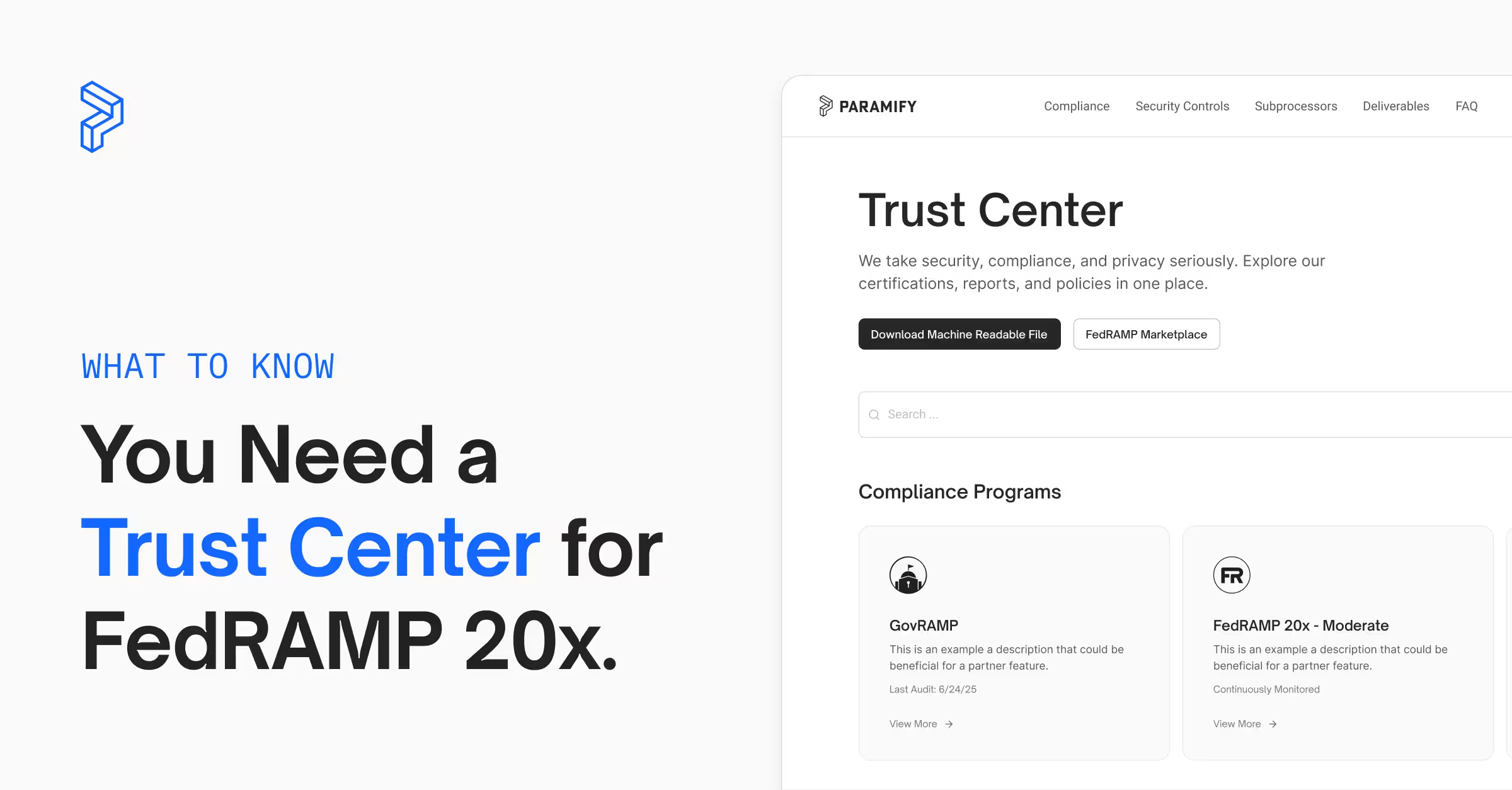
If you're a cloud service provider (CSP) pursuing FedRAMP 20x authorization, a trust center is a formal requirement. This post covers what a trust center actually is, what FedRAMP 20x specifically demands from one, and how Paramify automates the entire thing so you can stop managing compliance manually and start proving it continuously.
What is a Trust Center?
A trust center is a dedicated website or platform where a company makes its compliance and security information available to customers, agencies, auditors, and partners in a clear, consumable format.
The History
The concept of a trust center started in the early 2020s as security-conscious buyers started demanding more than a SOC 2 report once a year.
Benefits
A trust center gives you a permanent, controlled place to publish deliverables, share your security posture, and let the right people see the right information without a back-and-forth email chain every time someone asks for your SSP.
Think of it as a source of truth for your authorization data.
Instead of a prospective customer submitting a help desk ticket and waiting two weeks to receive a redacted PDF, they log into your trust center and see exactly what they need — your control implementation statuses, your leveraged systems, your interconnections.
The Goal: Real-Time Security Awareness
A well-built trust center reflects your live security posture that automatically updates as your environment changes, not just a static screenshot.
That's the direction the industry is heading, and it's exactly what FedRAMP 20x requires.
Why is FedRAMP 20x Changing Compliance Reporting?
The GSA introduced FedRAMP 20x in March, 2025. It’s the most significant overhaul of the FedRAMP program to date.
The core idea: stop treating security compliance as a documentation exercise and start treating it as an engineering discipline.
Under the old Rev. 5 model, CSPs spent 12 to 18 months producing mountains of static documentation, submitted it to a centralized FedRAMP repository, and then repeated the whole exercise during annual audits.
Agencies waited months for reports that were outdated before they arrived.
The process was expensive, slow, and rewarded thorough paperwork over actual security.
FedRAMP 20x flips that model.
- More than 80% of requirements now have automated validation — no narrative explanations required, compared to 100% of traditional controls that needed written documentation.
- KSIs (Key Security Indicators) replace checkbox controls.
- Continuous monitoring replaces point-in-time assessments.
- Trust centers replace the centralized FedRAMP document repository as the mechanism for sharing authorization data with agencies.
The underlying philosophy: CSPs should share honest information about their security decisions, and agencies should be able to verify that posture in real time by accessing a live data source instead of static, outdated documents.
Is a Trust Center Required for FedRAMP 20x?
Yes. Full stop.
Do You Need a Trust Center
for FedRAMP 20x?
FedRAMP published the Certification Data Sharing (CDS) Standard in June 2026. This formally establishes how CSPs must store and share FedRAMP authorization data with federal agencies.
Basically: if you want FedRAMP 20x authorization, you need a trust center. Building one manually is painful. Maintaining one continuously is even harder. More on that in a minute.
What Does FedRAMP 20x Actually Require from Your Trust Center?
The Authorization Data Sharing Standard is specific. Here's what your trust center needs to do:
Visibility: Put Your Trust Center Where Agencies Can Find It
Your trust center must be prominently placed on your core website and clearly labeled as FedRAMP-related. Burying it in a footer link or tucking it behind a "Security" page that takes three clicks to find doesn't meet the standard.
Federal procurement teams need to locate it without a map.
Stored Authorization Data
Your trust center can contain the full set of FedRAMP certification artifacts:
- SSPs
- POA&Ms
- Significant Change Notifications (SCNs)
- Incident reports
- Leveraged services
- Any other required materials.
These need to reflect your current postures, so they can't be static files from your last assessment.
Both Human-Readable and Machine-Readable Formats
This is where most manual approaches fall apart. FedRAMP 20x requires your authorization data in two formats simultaneously: human-readable for security teams and procurement officers making risk decisions, and machine-readable (OSCAL) for federal agencies using automated systems to verify your compliance posture.
Well-documented APIs for machine access are expected.
Continuous KSI Validation
Your trust center needs to reflect live KSI status.
FedRAMP 20x wants to know what your environment looks like today. It isn't interested in what it looked like during your last audit.
That means your trust center has to stay in sync with your actual systems, not a document you update once a quarter.
Controlled Access with Accountability
You manage who sees what. CSPs are responsible for protecting intellectual property while still providing appropriate transparency to agencies, Independent Assessors, and other authorized stakeholders.
Access to restricted materials needs to be grantable on demand, with a clear contact channel for agencies requesting it.
What’s the Problem with Building a Trust Center Manually?
Let's be honest about what "build it yourself" actually means here.
You need a live website connected to your compliance program. It needs
- To automatically pull updated control implementation statuses and POA&Ms, SCNs, and KSI evidence as your environment changes.
- To produce OSCAL-formatted machine-readable output for agency API access.
- Role-based access controls so a Independent Assessor can see your full package while an agency contact sees only what's relevant to their review.
- To stay current — not just at authorization time, but continuously, for the life of your FedRAMP authorization.
That's a significant engineering investment on top of an already demanding compliance program.
CSPs who try to build and maintain this manually end up with a static page that satisfies the letter of the requirement while completely missing the spirit of it. FedRAMP's reviewers know the difference.
How Much Does it Cost to Build a Security Trust Center?
The honest answer depends on how you build one — and the range is enormous.
Building a trust center from scratch:
A custom trust center can easily cost 100k+.
Without a platform, you're looking at the cost of a developer (or two) scoping the architecture, building the website, wiring up API connections to your compliance tools, producing OSCAL-formatted output, implementing role-based access controls, and then maintaining all of it as FedRAMP's ADS requirements continue to evolve.
That's a reasonable six-figure investment in engineering time before you've written a single line of compliance documentation — on top of a FedRAMP 20x process that already runs $150k to $3M+ in total authorization costs.
Standalone trust center tools:
Standalone trust center tools typically run anywhere from 3,600 to $48,000 a year.
FYI: Some trust centers operate separately from your compliance program. This means your trust center and your SSP are two different systems you have to keep in sync manually. That can be a hidden ongoing cost most vendors don't mention on the pricing page.
Trust center as part of Paramify:
If you're using Paramify for FedRAMP 20x, your trust center is included in your yearly subscription. No separate product, no add-on fee, no second system to manage.
The trust center is built into the platform and pulls directly from the same data driving your SSP, KSI evidence, POA&Ms, and control statuses — so the thing that keeps your compliance program current also keeps your trust center current, automatically.
Customers using Paramify move 90% faster and spend about half the cost compared to the traditional manual approach.
→ Watch a video demo to see what Paramify's platform would cost for your organization's specific scope and timeline.
How Does Paramify Automate Your FedRAMP 20x Trust Center?
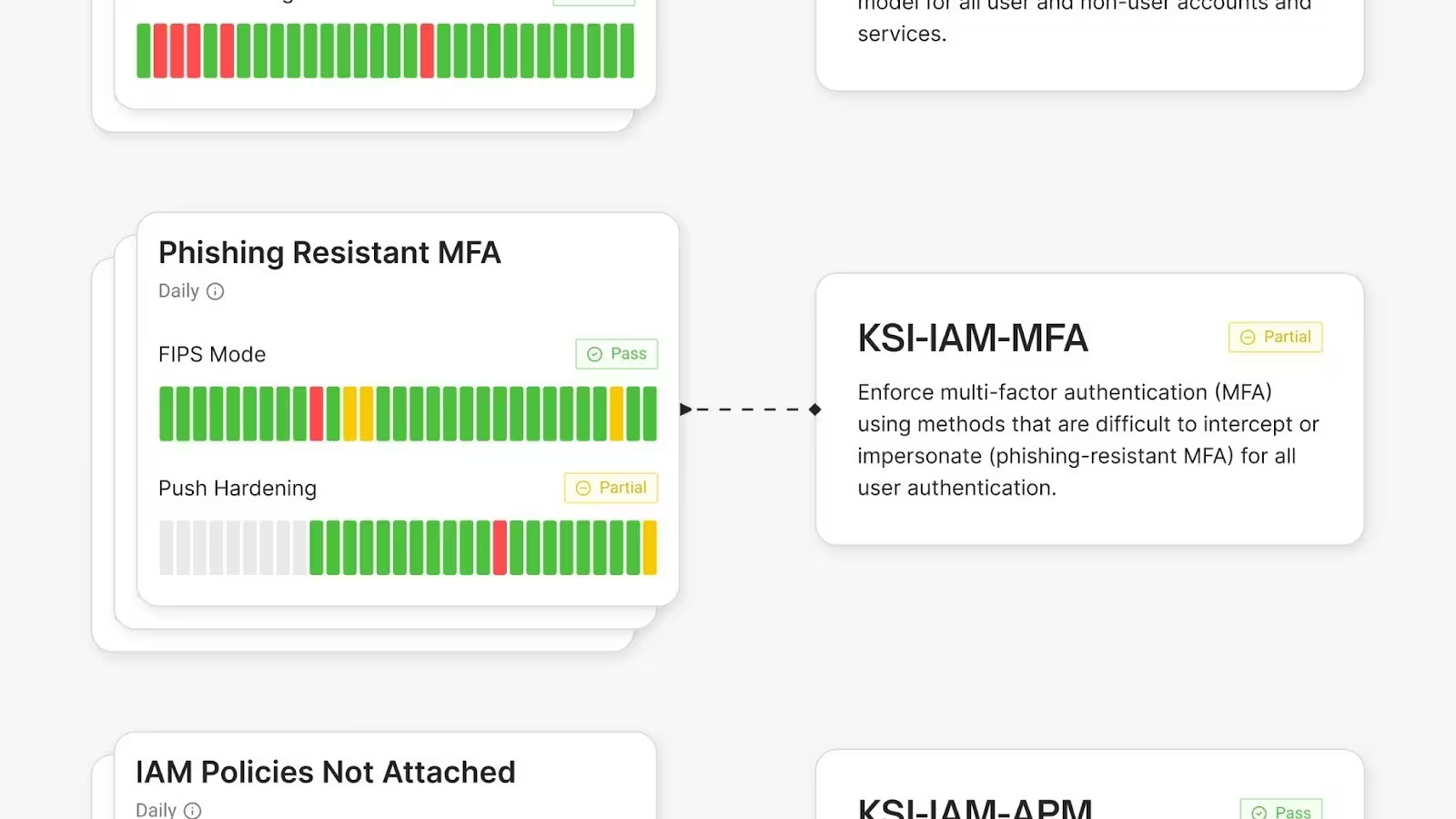
Paramify built trust center functionality directly into the platform. Here's what that means in practice.
Publish Everything Your Agencies Need — Automatically
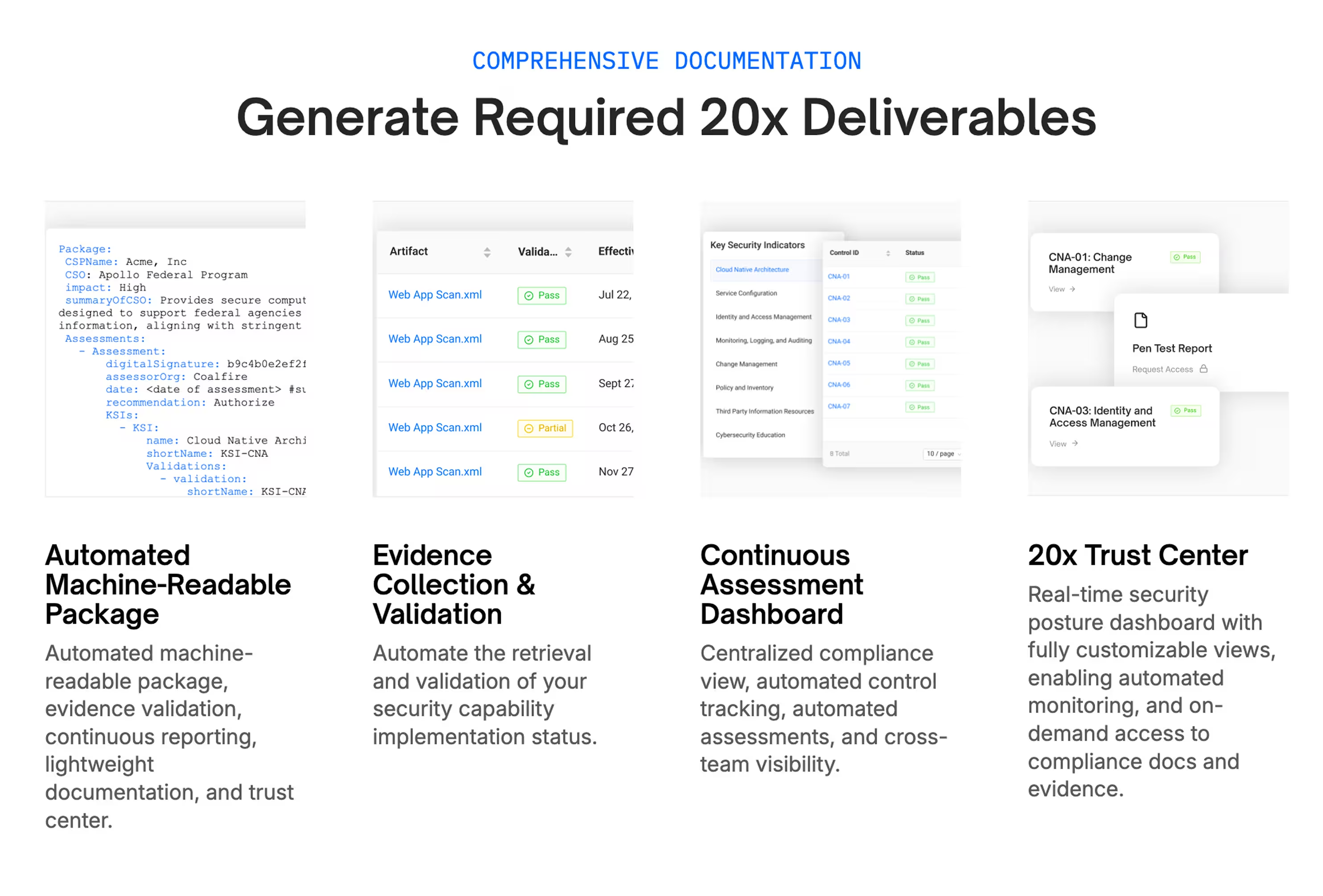
With Paramify, you can publish deliverables, interconnections, leveraged systems, and control implementation statuses directly to your trust center from the same platform where you build and maintain your compliance program.
There's no manual export, no copy-paste, no separate system to manage. Your trust center reflects your live Paramify data.
That matters because your SSP in Paramify isn't a static document. It updates automatically when you update a Risk Solution. Change one security capability, and every mapped control and document propagates the update.
Your trust center stays in sync because it's pulling from the same source of truth.
Granular Access Control, Built In
Not every stakeholder should see everything. Paramify lets you manage access at the individual deliverable level.
You can grant a prospective agency customer access to your SSP summary while keeping your full internal documentation restricted. Or grant a Independent Assessor complete package access for an assessment.
You track who accessed what, and you can adjust permissions without touching a line of code.
This is the kind of access management FedRAMP's ADS standard expects, and it's included in the platform rather than bolted on.
Machine-Readable ATO Packages Without the Pain
Paramify automatically generates OSCAL-formatted packages natively. Your trust center provides both the human-readable view for security teams making procurement decisions and the machine-readable output that federal agency systems can query directly.
You don't need a separate toolchain or a developer to convert your compliance data into the right format.
KSI Evidence Retrieval and Continuous Validation
Paramify automatically retrieves, stores, and validates the evidence required for continuous KSI assessment.
Your trust center doesn't just display your compliance status — it's backed by validated evidence that a Independent Assessor can verify and that FedRAMP's automated systems can query. This is what separates a real-time trust center from a compliance marketing page.
One customer team used Paramify to collect KSI evidence in machine-readable format with a single person and submitted their full 20x package within two weeks.
Fast to Deploy, Easy to Maintain
"The onboarding was fantastic. From signing the contract to seeing value in our org wasn't 90 days — it was literally three days." - Tom Maloney, COO, UberEther
Getting started with Paramify's trust center doesn't require a multi-month implementation. The platform is designed to get you managing compliance and generating documentation within hours.
Your trust center launches alongside your compliance program, not as a separate project after it.
We know Paramify isn't the right fit for every organization. Read more to find out if Paramify is the right fit for you.
Why are Trust Centers Important For FedRAMP 20x?
FedRAMP 20x is driving the formal requirement, but the shift happening underneath it applies to every regulated industry.
The compliance world is leaving behind the outdated model where you hand a prospective customer a two-year-old SOC 2 report and ask them to trust you.
Whether it’s federal agencies, enterprise security teams, or regulated-industry procurement departments, buyers increasingly expect live, verifiable proof of security posture before they sign a contract.
A trust center is how you provide that.
For CSPs selling into the federal market, a well-maintained trust center doesn't just satisfy a FedRAMP 20x checkbox. It also
- Shortens sales cycles by giving agency procurement teams exactly what they need during due diligence, without a week-long back-and-forth.
- Demonstrates that your security program is real and ongoing, not a compliance exercise you completed two years ago and haven't touched since.
- Signals something that's genuinely rare in this industry: you're not afraid to show your work.
Security theater is everywhere. A trust center is how you prove you're not doing it.
Ready to Build Your Trust Center?
FedRAMP 20x made the trust center a requirement. But the CSPs who treat it as a compliance checkbox and build a static page to satisfy it are going to find themselves revisiting that work constantly as requirements evolve and agencies start actually using the data.
Paramify builds your trust center as a live extension of your compliance program — connected to your KSI evidence, your SSP, your POA&Ms, and your control statuses, updated automatically as your environment changes. You get the machine-readable output FedRAMP requires, the access controls agencies expect, and the real-time transparency that separates a genuine security program from security theater.
→ Schedule a demo to see Paramify's trust center in action, or check out Paramify's own trust center as a live example of what yours could look like.
Read More:
- Everything you need to know about FedRAMP 20x Moderate
- Which is best, FedRAMP 20x or Legacy Rev 5?
- Is FedRAMP 20x less secure?
- Your FedRAMP readiness checklist: Find out if you're prepared.
Frequently Asked Questions
Is a trust center the same as a FedRAMP Marketplace listing?
No. Your FedRAMP Marketplace listing is a public entry managed by FedRAMP that confirms your authorization status.
Your trust center is owned and operated by you, and it's where agencies and auditors access the live authorization data — SSPs, POA&Ms, KSI evidence, and more — that supports your listing.
The Marketplace tells agencies you're authorized. Your trust center tells them what that actually means.
What's the difference between a trust center and an SSP?
Your SSP is one artifact that lives inside your trust center. The trust center is the broader system for sharing and validating your authorization data, including POA&Ms, SCNs, KSI status, incident reports, and leveraged system information — all in real time. Think of the SSP as a chapter and the trust center as the full book, kept current.
Do I need a trust center for FedRAMP 20x Class B, C, D (Formerly Low, Moderate, and High)?
FedRAMP 20x Phase 1 covered Class B certification (Low impact level authorization). Phase 2 is actively expanding to Class C (Moderate).
High-impact systems are not currently eligible for the 20x path.
Trust center requirements are continuing to evolve as FedRAMP formalizes the ADS Standard. Paramify tracks these changes and keeps your setup current so you're not manually chasing a moving target.
How long does it take to build a trust center with Paramify?
A lot faster than building one from scratch.
Selecting the components for your trust center is a simple process and can be done in minutes to hours.
Because Paramify's trust center pulls directly from your live compliance program, you're not starting from zero — you're publishing what already exists in the platform.
Most customers are fully up and running in days rather than months, with automated evidence pipelines and machine-readable output included.

.svg)
.svg)