In This Article
FedRAMP 20x requires you to prove your controls are working right now, continuously, with evidence pulled from your production systems and validated against Key Security Indicators. It replaces the point-in-time audit and the narrative System Security Plan with machine-readable data your systems emit on their own.
If you sell cloud services to federal agencies, this is the path forward.
So, whether you’re considering getting FedRAMP or looking to update to future-proof your security, here is what 20x asks of you and how Paramify can help your company succeed at 20x.
TL;DR
- 20x replaces narrative documentation with continuous, machine-readable evidence tracked against Key Security Indicators (KSIs).
- A Trust Center is not optional at Class C. It is the required channel for sharing certification data, and agencies cannot be denied access.
- Legacy FedRAMP has a hard timeline: no new applications after June 11, 2027, and existing Certifications sunset December 31, 2028.
Why does FedRAMP 20x exist?
Basically, 20x treats security as an observable system instead of a documentation problem. This gets better software into agency hands faster and allows security teams to focus on what matters most — building secure systems.
Problem 1: Inaccurate documentation as the focus
FedRAMP has run on documents since the get go. CSPs wrote 1,000+ page narratives explaining how each control was satisfied, an assessor verified it once, and the package started drifting out of date the moment a deployment went out.
Problem 2: Sponsorship requirement blocked progress
Under Rev 5, you needed a federal agency willing to invest time and political capital to sponsor you before other agencies could use your system.
We lived through the pain of that one. Paramify was listed as FedRAMP High Ready and . . . . waited. Our security was ready. Our product was ready. The demand was real. We were stuck behind a procurement formality.
FedRAMP 20x solves the problem by dropping the sponsorship requirement to allow federal agencies access to better, more modern software sooner.
What does 20x require you to prove?
Legacy (Rev 5) FedRAMP required you to state a control was in place and an assessor checked your narrative.
Under 20x, you supply production-derived evidence. Your system has to demonstrate the control is active, on an ongoing basis.
Three requirements make the difference:
- Automated KSI verification. At Class C you must implement at least two automated verification methods per KSI. That is a hard requirement at this Class, not a recommendation the way it is at Class B. If you are new to the concept, KSI vs. Control covers the distinction.
- Historical KSI metrics. Class C requires six months of historical KSI data. Class D requires eighteen. You either need to show your data, or show how you’re collecting it to achieve FedRAMP Certification.
- A Trust Center. Certification data gets shared through a Trust Center, and the rule is explicit that agencies cannot be denied access. This replaces ad hoc document exchange over email.
Class C adds more on top: MFA for all users and phishing-resistant MFA for privileged users, more robust incident handling, and continuous vulnerability detection across persistent, complete, drift, and sample methods.
Requirement details are published in the FedRAMP 20x Class C ruleset at fedramp.gov.
Who actually needs to move to 20x?
Anyone selling cloud services to federal agencies who is not already certified, plus every currently Rev 5-Certified provider is on a clock.
The dates that matter:
- January 1, 2027 — CR26, which requires Legacy FedRAMP orgs to adopt many 20x requirements, becomes mandatory for all stakeholders.
- June 11, 2027 — FedRAMP stops accepting new Rev 5 Certification applications.
- December 31, 2028 — Existing Rev 5 Certifications sunset unless FedRAMP directs otherwise.
FedRAMP's own guidance is that Class A is the default on-ramp, not Class C. Do not jump straight to Class C or D without an actual agency requirement driving it.
Our step-by-step guide to Class A covers that path, and every FedRAMP 20x deadline you need to know has the full timeline.
What do teams get wrong about 20x?
Treating it like a documentation refresh. 20x is not some new template. If your assurance program cannot be expressed as system evidence and telemetry, it does not translate.
Assuming 20x is easier. Sorry, the bar for proof did not go down with 20x. What went away is the narrative writing and the sponsorship politics. The actual requirements to prove your security is robust are higher than ever, you just don’t have to focus on the same busywork requirements you had in the past.
How does Paramify help you meet 20x requirements?
Paramify is a risk management platform. It organizes security by ownership, tracks control effectiveness against live system state, and generates any required reporting as a byproduct of that.
The Certification is what happens when the underlying risk data is accurate and current.
For 20x specifically, the mechanism is APIs rather than manual review:
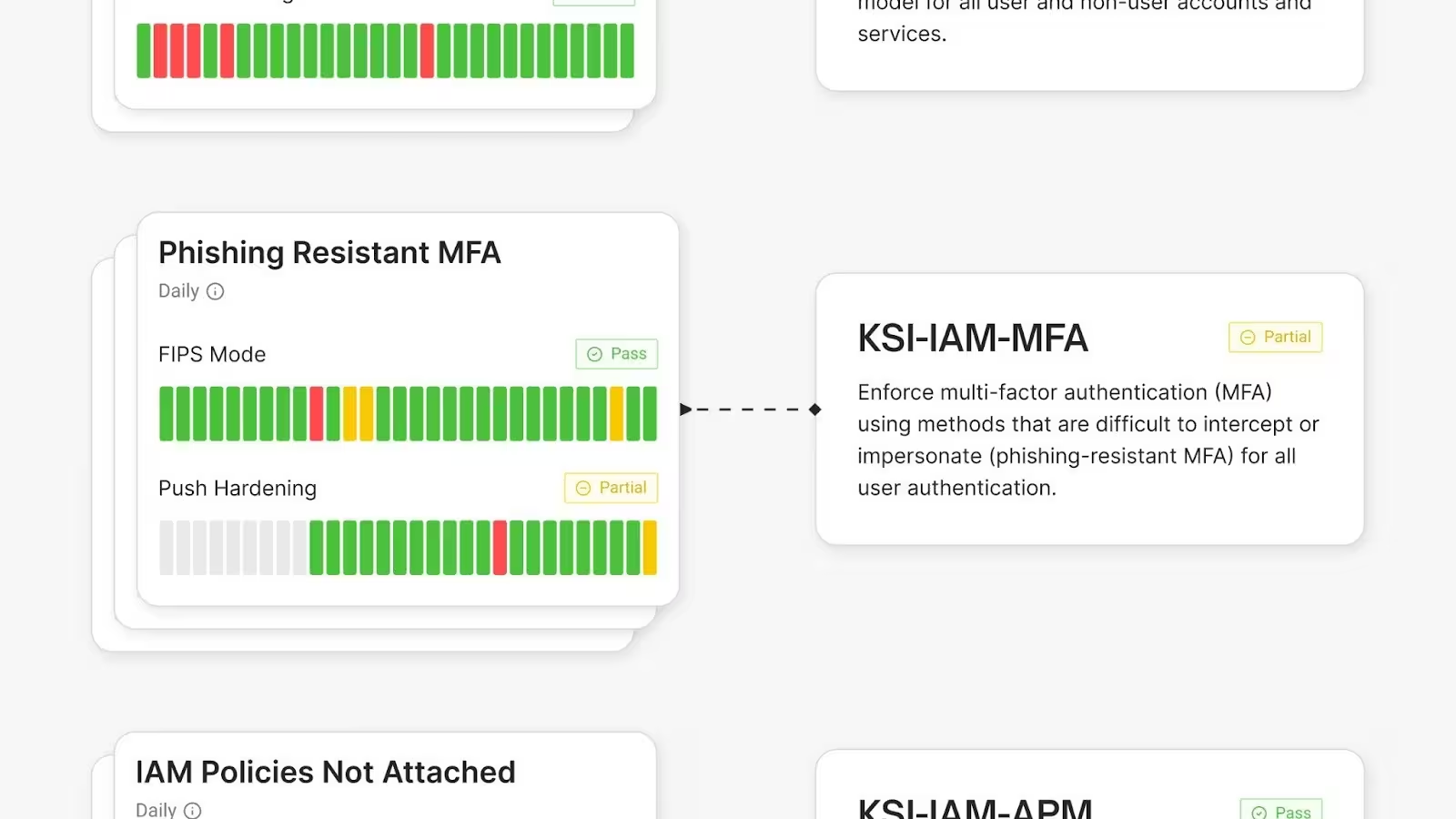
- Evidence collection. Paramify pulls evidence from the systems you already run, mapping existing tooling such as AWS, Okta, and CrowdStrike to requirements from any framework. Validation returns a Pass, Fail, or Partial status against each KSI before an assessor ever sees it. How Paramify automates evidence collection and validation walks through the flow.
- CPO and SDR generation. Both are produced as machine-readable JSON conforming to the schemas published at fedramp.gov/schemas. When we published Paramify's own CPO, we included ten additional fields beyond the required set. It validates clean, which is the kind of detail you only learn by shipping one.
- Trust Center publication. Your Trust Center generated with Paramify publishes your current KSI status on an ongoing basis, so an agency sees live posture rather than a document describing a moment in the past.
- Ongoing Certification. Historical KSI metrics accumulate from the day you connect your systems, which is the only way to have six months of history when you need six months of history.
Paramify was the first GRC tool to receive FedRAMP 20x Class C Certification, earned in Cohort 1 in Q1 2026 — and we used our own platform to do it. In Phase 1, Paramify helped 7 of 25 organizations reach independent Certification. More than 30% of the FedRAMP Marketplace uses Paramify to earn and keep FedRAMP Certification.
What Paramify does not do: the annual independent assessment. Of the eleven things CR26 can ask of a provider, exactly one legally has to come from outside your walls. Everything else is a tooling and process problem.
What changed in the terminology?
CR26 took effect July 4, 2026 and retired a long list of familiar terms. If you are reading FedRAMP documentation with Rev 5 vocabulary in your head, here’s the translation.
The Security Decision Record is where most of the old SSP content actually lands: a maintained record of every security decision you have made, mapped to FedRAMP rules, KSIs, and for now Rev 5 controls.
Get Started with 20x, the simple way
You came here asking what FedRAMP 20x requires, and the honest version is that it requires a different kind of program, not a different kind of document.
20x asks you to prove your controls are working continuously, with evidence your production systems generate, validated against Key Security Indicators, and published where agencies can see it.
The narrative SSP is gone. Sponsorship is gone. What replaced them is a higher bar on proof and a much shorter path to market for teams whose security is genuinely in order.
Paramify was built around that model rather than adapted to it, which is why our own Class C package came out of the same platform our customers use. If your KSI evidence clock has not started, that is the thing to fix first, because it is the one requirement no tool can accelerate retroactively.
Next steps:
- Compare the two paths side by side: FedRAMP Rev 5 vs. FedRAMP 20x
- Check your dates against the full CR26 timeline: every FedRAMP 20x deadline you need to know
- See what a 20x Trust Center looks like in practice: FedRAMP 20x Trust Center
- Start collecting evidence: request a free trial of Paramify
Schedule Your Free Demo of Paramify
Get a live demo to see how Paramify simplifies risk management and compliance reporting while helping you improve your security. Sign up below to schedule a time or send over any questions you have.
FAQ
Is FedRAMP 20x replacing Rev 5? Yes, on a published timeline. FedRAMP stops accepting new Rev 5 Certification applications on June 11, 2027, and existing Rev 5 Certifications sunset December 31, 2028 unless FedRAMP directs otherwise.
Do I still need an agency sponsor? No. 20x Program Certification removes the agency sponsorship requirement. The PMO takes that role.
What is a KSI? A Key Security Indicator is an outcome-based measure of whether a security capability is actually working, verified through automated methods rather than a written narrative. See KSI vs. Control.
Which Class should I apply for? Class A unless an agency contract requires more. FedRAMP recommends A as the default entry point and flags jumping to C or D without a real agency requirement as a common mistake.
Can I backfill six months of KSI history? No. This is the hardest constraint in 20x. Start collecting at least six months before your target Class C application date.
Do I still need a 3PAO? You need a fresh independent assessment from a FedRAMP-Recognized assessor within the previous three months for Class B and above. It is optional at Class A.
What happened to my POA&M? POA&Ms are eliminated under CR26 and replaced with an Accepted Weaknesses list. This is mandatory, not optional.
Is the SSP really gone? The narrative SSP is. It is replaced by the Certification Package Overview and the Security Decision Record, both machine-readable JSON.
Is a Trust Center actually required? At Class C, yes. It is the required channel for sharing certification data with agencies, and agencies cannot be denied access.
What if we are still on Rev 4? Rev 4 is not a recognized CR26 track. There is no Rev 4 fast lane. Treat it as a net-new Certification and plan accordingly.
Does 20x mean less work? Less writing, more engineering. The documentation burden drops. The proof burden rises.
Can Paramify handle frameworks beyond FedRAMP? Yes. The data model reuses work across frameworks, so evidence gathered for FedRAMP applies to SOC 2, CMMC, DoD, FISMA, and GovRAMP. Reporting can be automatically generated in whatever formats needed for your framework.
How do I know if my program is ready for production-derived evidence? Ask whether you could produce, today, an automated check proving a given control is active in production. If the answer requires a person taking a screenshot, that is the gap.

.svg)
.svg)