In This Article
Watch: Learn what VDR replaces in your ConMon program with Isaac Teuscher
If you run a FedRAMP Certified program, you've probably asked some version of this question lately: what happens to our monthly ConMon scans now that FedRAMP VDR is mandatory, and how much of our RA-5 and SI-2 work still counts?
It's a fair thing to worry about. Your team has spent years tuning Tenable or Qualys scans, building POA&M workflows, and getting agency reviewers comfortable with your monthly package, and now VDR has changed the process.
The good news is that most of what you've built carries over. In this article, we'll walk through how VDR maps to the NIST 800-53 controls you already know, what changes about your scanning cadence and reporting, and what you need to have in place to meet the VDR deadline.
What is FedRAMP VDR, and what does it replace?
FedRAMP's Vulnerability Detection and Response (VDR) standard covers how you find and fix vulnerabilities. Its companion, Vulnerability Evaluation and Reporting (VER), covers how you rate those vulnerabilities and report them to agencies.
If you want the full breakdown of the two, we cover it in What Are FedRAMP VDR and VER?
If you're like us here at Paramify, you've been running monthly ConMon scans as part of your FedRAMP program for a long time. Each month you scan your databases, containers, hosts, and network, find CVEs, and report them in the POA&M you share with your federal stakeholders.
VDR drops the fixed list of required scans and the monthly rhythm. It asks you to "systematically, persistently, and promptly discover and identify vulnerabilities" using whatever methods fit your system: scanning, pen tests, bug bounties, red team assessments, threat intelligence, supply chain monitoring, and automated control testing all count.
FedRAMP Notice NTC-0014 made VDR and VER mandatory for every FedRAMP-certified cloud service, Legacy Rev 5 included, effective December 7, 2026. Providers that aren't following the rules by March 7, 2027 risk having their certification revoked.
Why monthly vulnerability scanning is no longer enough
NTC-0014 says it plainly: "the legacy monthly vulnerability scanning process that most FedRAMP Rev5 Certified cloud services currently follow is insufficient."
The reason is speed. The mean time to exploit a vulnerability is down to a few days, or even a few hours.
AI has changed the threat landscape, and new vulnerabilities are discovered and exploited quickly.
If you scan on the first of the month and a critical, internet-reachable vulnerability appears on the third, you won't see it for almost four weeks. By then, the window to fix it before someone exploits it has likely closed.
The VDR remediation clock reflects our new reality. At Class C (Moderate), a likely exploitable, internet-reachable vulnerability with the highest potential agency impact has to be addressed in 2 days.
At Class D (High), it's 12 hours. Those timelines don't work with a monthly scan, no matter how efficient your team is after the report lands.
We explain how those deadlines are calculated in FedRAMP VDR and VER Explained.
How FedRAMP VDR maps to RA-5 vulnerability monitoring and scanning
If you've mapped your Nessus or Qualys scans to RA-5 for years, you're already doing most of what VDR asks. NIST SP 800-53 RA-5 requires you to:
- Monitor and scan for vulnerabilities in the system and hosted applications
- Analyze vulnerability scan reports
- Remediate legitimate vulnerabilities in accordance with an organizational assessment of risk
- Share information from the process with designated stakeholders
VDR keeps every one of those. But now, RA-5 leaves "organizational assessment of risk" up to you.
With VDR and VER every finding gets rated on whether it's
- Likely exploitable
- Whether it's internet reachable
- How much damage it could do to an agency (the PAIN scale, N0 through N5).
Those three factors set the remediation deadline.
So RA-5 told you to remediate based on risk, but VDR tells you how to measure the risk and how fast to act on it.
How FedRAMP VDR maps to SI-2 flaw remediation enhancements
SI-2 is where automation comes in, and three of its enhancements line up closely with VDR:
All three point to the same principle: use automation to find flaws, figure out how to fix them, and apply the fix.
VDR and VER are built on that principle too.
They ask you to use automation to persistently discover vulnerabilities across every detection method you run, then track remediation and report status on a set schedule.
Here's how the pieces line up:
Do you need to rebuild your vulnerability management program for VDR?
Probably not.
If your Rev 5 offering already implements RA-5 and the SI-2 enhancements, and you're using automation to validate what's on your system and report it, you're closer than you might think. The gaps usually come down to three things.
How FedRAMP VDR and VER support CISA BOD 26-04
VDR and VER exist largely so agencies can comply with their own new mandate. CISA's BOD 26-04, Prioritizing Security Updates Based on Risk, issued June 10, 2026, requires federal civilian agencies to run a risk-based vulnerability assessment and remediation process. It weighs public exposure, inclusion in CISA's Known Exploited Vulnerabilities catalog, automatability, and technical impact.
Agencies can't make those decisions about your cloud service without data from you.
VDR and VER standardize what that data looks like and how often it arrives, so agencies can understand the risk of using your offering at any point in time.
Our breakdown of BOD 26-04 and FedRAMP VDR walks through how CISA's four factors translate into FedRAMP's rating rules.
How Paramify helps you meet FedRAMP VDR deadlines
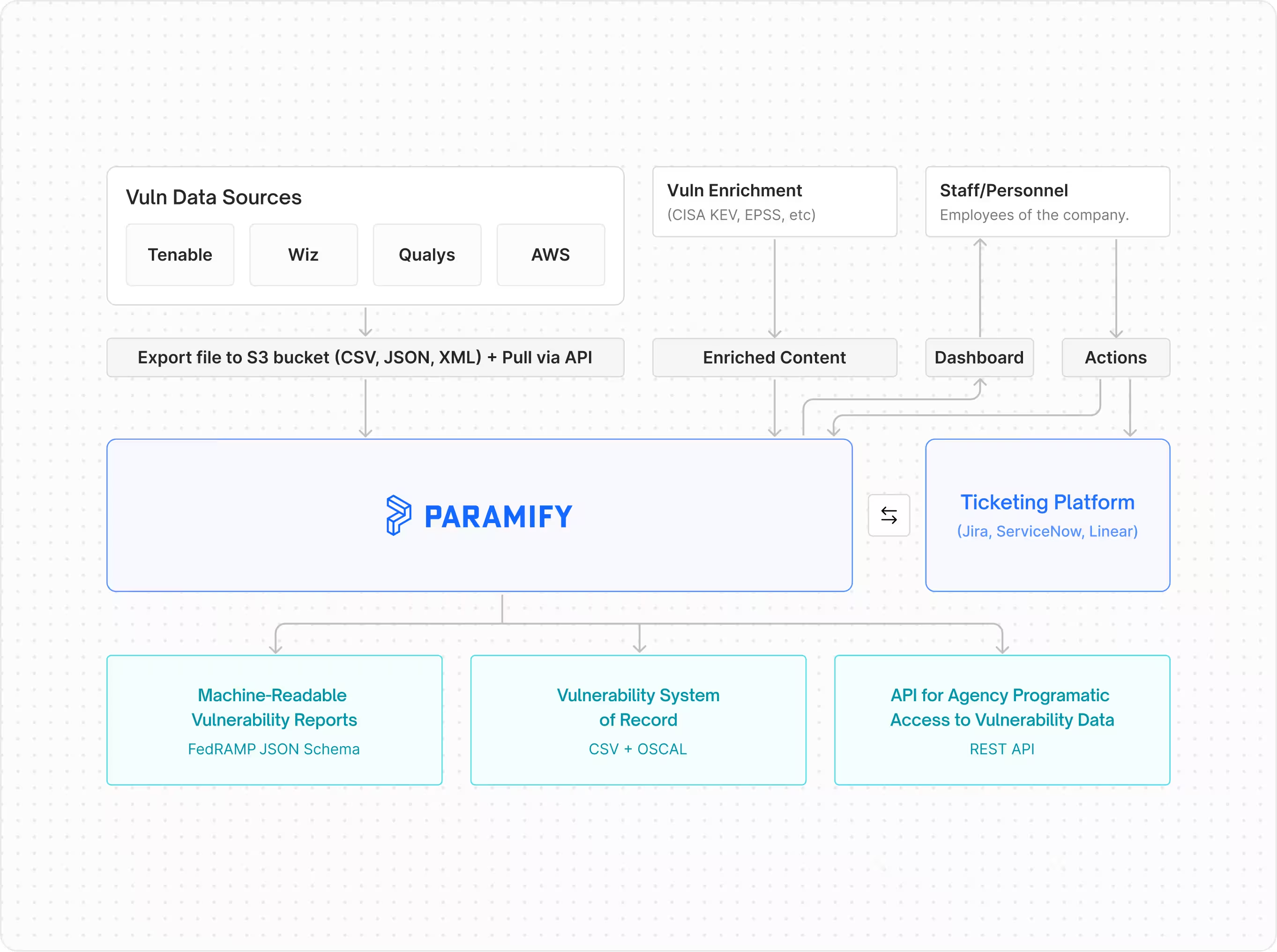
Your scanners find vulnerabilities. Paramify maps them to your controls, rates them, tracks them against deadlines, and reports them to agencies, so the work your team already does for RA-5 and SI-2 translates directly into VDR and VER compliance.
Here's what that looks like in practice:
Meeting the VDR deadline without starting over
Monthly ConMon scans served FedRAMP programs for a long time, but they can't keep up with how fast vulnerabilities get exploited now, and NTC-0014 has made that official.
The upside is that VDR builds on the same practices RA-5 and SI-2 have always asked for: automated detection, risk-based remediation, and clear reporting to your federal stakeholders. For most Legacy Rev 5 providers, the work ahead is tightening scan frequency, closing coverage gaps, and modernizing how findings get rated and reported before December 7 (with grace period through March, 2027).
If you have questions about where your program stands, or you'd like to see how Paramify handles mapping, deadlines, and VDR reporting, reach out with any questions or request a live demo. We're happy to walk through it with you.
Learn more
- What Are FedRAMP VDR and VER? The Difference, the Deadline, and the PAIN Scale
- Understanding BOD 26-04 and FedRAMP VDR: What You Need to Do to Stay Compliant
- FedRAMP Notice NTC-0014 and CISA BOD 26-04: What CSPs Need to Know About the VDR Mandate
- FedRAMP VDR and VER Explained
- Which CR26 Deliverables Does Paramify Automate?
- How Paramify Automates Evidence Collection, Validation, and Issue Creation
FAQ
What replaces monthly ConMon scans under FedRAMP VDR?
Persistent, automated vulnerability detection. VDR allows scanning, pen tests, bug bounties, red team assessments, threat intelligence, and supply chain monitoring, run often enough to meet remediation deadlines that can be as short as 2 days at Class C.
When is FedRAMP VDR mandatory?
December 7, 2026, for all FedRAMP-certified cloud services, including Rev 5. FedRAMP allows a grace period under a corrective action plan through March 7, 2027. After that, certifications for non-compliant services can be revoked.
Does FedRAMP VDR replace RA-5 and SI-2?
No. VDR builds on the same practices. RA-5 already requires scanning, analysis, and risk-based remediation, and SI-2 enhancements 2, 4, and 5 call for automated remediation status, patch management, and updates. VDR and VER define how to rate risk and how fast to act.
How often do I need to scan for VDR?
FedRAMP sets drift-detection cadences by class, such as every 14 days at Class C and every 7 days at Class D. In practice, the remediation deadlines push most providers toward daily or every-few-days detection so high-risk findings surface in time to fix them.
What do I have to report to agencies under VER?
A human-readable report at least monthly, plus machine-readable JSON history agencies can retrieve on their own. At Class C, FedRAMP expects that JSON history at least every 14 days.
How does VDR relate to CISA BOD 26-04?
BOD 26-04 requires federal civilian agencies to prioritize vulnerability remediation based on risk. VDR and VER give agencies the standardized data from cloud providers they need to make those decisions.
Can Paramify help if we already use Tenable, Qualys, or Wiz?
Yes. Paramify works with the scanners you already run. It maps their findings to your controls and to VDR and VER, rates each finding, calculates deadlines, and produces the reports agencies need.