In This Article

If you sell software to the U.S. government, two acronyms decide whether your product can be deployed: FedRAMP and DoD IL ATO. They sound similar, are both NIST 800-53 frameworks, and are often mentioned in the same sentence. But, my friend, they are not the same authorization and getting the difference wrong here will cost you a year of runway.
This guide breaks down the real differences between a FedRAMP ATO and a DoD Impact Level (IL) ATO: who sponsors each, what controls apply, how the processes diverge, and which one you should pursue first.
TL;DR: FedRAMP vs DoD IL ATO
A FedRAMP ATO authorizes a cloud service offering to handle unclassified federal data across civilian agencies, using NIST SP 800-53 baselines (Low/Class B, Moderate/Class C, or High/Class D).
A DoD Impact Level (IL) ATO authorizes that same offering to handle DoD-specific workloads at IL2, IL4, IL5, or IL6. Each of these adds tailored controls on top of a FedRAMP baseline.
FedRAMP is sponsored by a federal agency or the FedRAMP Board. A DoD IL ATO is sponsored by a DoD Mission Owner and assessed against the DISA Cloud Computing Security Requirements Guide (CC SRG).
Most vendors targeting both markets pursue FedRAMP High first, then layer on the DoD-specific overlays to reach IL4, IL5, or IL6.
What is a FedRAMP ATO?
The Federal Risk and Authorization Management Program (FedRAMP) is the U.S. government's standardized program for authorizing cloud service offerings (CSOs) to operate inside federal civilian agencies.
A FedRAMP ATO (Authority to Operate) is the formal sign-off from an Authorizing Official (AO) that a cloud product has been assessed against the relevant NIST SP 800-53 control baseline and is approved for federal use.
FedRAMP has three main impact baselines, Class B, C, and D. (These are recently renamed from Low, Moderate, and High):
- FedRAMP Class B (formerly Low): Low-impact data, around 156 controls (Rev 5). Often used for public-facing tools and Low Impact Software-as-a-Service (LI-SaaS) offerings.
- FedRAMP Class C (formerly Moderate): Most federal SaaS lives here. Roughly 323 controls. Used when a confidentiality, integrity, or availability loss would cause serious harm but not catastrophic damage.
- FedRAMP Class D (formerly High): About 410 controls. Required for systems handling sensitive law enforcement, financial, health, or emergency services data.
A FedRAMP ATO is a hard prerequisite for federal civilian sales. It is also the foundation almost every DoD IL ATO is built on.
Get details on how much FedRAMP Certification Costs before you get started.
What is a DoD ATO?
The Department of Defense doesn't accept FedRAMP authorizations on their own for most of its workloads.
Instead, DISA (the Defense Information Systems Agency) maintains the DoD Cloud Computing Security Requirements Guide (CC SRG), which defines four impact levels (IL2, IL4, IL5, IL6) and the additional controls each level requires.
A DoD IL ATO is the authorization a Mission Owner — the DoD organization that will actually use the system — issues after assessing a cloud service against the appropriate Impact Level.
There is also a related artifact: a DoD Provisional Authorization (PA). DISA issues a PA to a Cloud Service Provider after the CSP has passed CC SRG assessment at a given Impact Level.
The PA is a reusable assessment that Mission Owners reference when issuing their own ATOs, not an ATO on its own.
In practice:
- CSPs (AWS GovCloud, Azure Government, Oracle GCH, Google Assured Workloads) earn DoD PAs at IL2/IL4/IL5/IL6.
- ISVs and SaaS providers running on those CSPs earn IL ATOs through a Mission Owner once their FedRAMP package plus DoD-specific overlays are in place.
The DoD ATO is what unlocks live deployment into DoD environments. The FedRAMP ATO is what unlocks the door to start that conversation.
FedRAMP vs DoD IL ATO: side-by-side comparison
| Dimension | FedRAMP ATO | DoD IL ATO |
|---|---|---|
| Governing framework | FedRAMP PMO + NIST SP 800-53 | DoD CC SRG (DISA) + NIST SP 800-53 |
| Baseline | Class B, Class C, or Class D | IL2, IL4, IL5, IL6 |
| Data scope | Unclassified federal data and CUI | Public DoD data through classified SECRET (IL6) |
| Sponsor | Federal agency or FedRAMP Board | DoD Mission Owner |
| Reusability | Package reusable across federal agencies via FedRAMP Marketplace | Mission Owner ATO is system-specific; DISA PA enables reuse |
| Approximate control count | 156 (B), 323 (C), 410 (D) | 125 (IL2), ~369 (IL4), ~431 (IL5), ~430 (IL6) |
| Hosting requirement | U.S.-based, FISMA-aligned | U.S. soil; IL5/IL6 require dedicated multi-tenant infrastructure separated from non-federal systems |
| Connectivity | Internet | IL4/IL5 via NIPRNet through a DISA CAP; IL6 via SIPRNet |
| Personnel | U.S. persons recommended | IL4: US Persons, ADP-1/SSBI; IL5: ADP-2/NACLC + NDA; IL6: cleared U.S. citizens with adjudicated SECRET clearance |
| Typical timeline | 12–24 months for Class D | 6–18 months on top of an existing FedRAMP package |
| Typical cost | $500K–$3M+ for Class D | $250K–$1.5M+ on top of FedRAMP for IL4/IL5 |
| Continuous monitoring | Monthly POA&M, annual assessment | Same, plus DoD-specific deltas reviewed by the Mission Owner's authorization team |
The single most important row in that table is the second-to-last: most DoD IL ATOs sit on top of a FedRAMP ATO. That's the bridge between the two programs and it's why nearly every vendor with a DoD authorization started with FedRAMP.
The 7 differences that actually change your roadmap
Anyone can list controls. The harder question is what those differences mean for your engineering team, your sales cycle, and your runway.
1. Who sponsors the package
A FedRAMP authorization needs an agency sponsor. A DoD IL ATO needs a DoD Mission Owner, which is a unit, command, or program office willing to take on the authorization decision. Mission Owners are picky. They will not sponsor a system that hasn't already cleared most of the FedRAMP work, because they don't want to absorb that cost themselves.
If you don't already have a Mission Owner identified, your real goal is FedRAMP High plus enough CC SRG mapping to make the conversation easy when one shows up.
2. Which controls apply
FedRAMP baselines come straight from NIST SP 800-53. The DoD CC SRG adds overlays — extra controls and parameter values that reflect DoD mission concerns.
- IL2 maps closely to FedRAMP Class C.
- IL4 is FedRAMP Class C plus a CUI-specific tailored set (and most vendors building for IL4 actually use FedRAMP Class D as the baseline now).
- IL5 is FedRAMP Class D plus a National Security Systems (NSS) overlay.
- IL6 is IL5 plus a classified overlay, and it lives on SIPRNet.
The deltas are not enormous in control count, but they touch the parts of the system that are hardest to change: tenant separation, encryption key custody, personnel access, audit log retention, and network boundary controls.
3. Where the data lives
| Authorization Level | Hosting Requirement |
|---|---|
|
FedRAMP Class D
(formerly FedRAMP High)
|
Can run on standard commercial GovCloud regions. |
| DoD IL5 | Must run on infrastructure physically separated from non-federal customers, with dedicated multi-tenant boundaries. |
| DoD IL6 | Must live on a SIPRNet-connected enclave inside a cleared facility. |
This has direct architectural consequences.
If you're targeting IL5 in your roadmap, build on a CSP that already has an IL5 PA from day one. Switching CSPs after you've started writing your SSP is one of the most expensive mistakes a vendor can make.
4. Who can touch the system
| Authorization Level | Personnel Requirement |
|---|---|
| FedRAMP | Recommends U.S. persons in privileged roles. |
| DoD IL4 | Requires U.S. Persons in privileged roles with ADP-1 / SSBI. |
| DoD IL5 | Adds ADP-2 / NACLC and an NDA. |
| DoD IL6 | Requires U.S. citizens with favorably adjudicated SSBIs and active SECRET clearances. |
Clearances take 9–18 months to process. If your engineering team is globally distributed, this is the constraint that will hit your delivery plan before any control does.
5. Cost and timeline
A FedRAMP Class D certification can run 3 to 24 months and $500K to $3M when you account for the Independent Assessor assessment, internal staff time, remediation, and the documentation package itself. The DoD overlay adds 6 to 18 months on top of that, plus another $250K to $1.5M.
The single biggest swing factor is documentation. The SSP for a FedRAMP High system commonly runs 800 to 2,000 pages; an IL5 SSP can push past 2,000 once the overlays are mapped.
The vendors who finish on time and on budget are the ones who don’t write their SSPs by hand. Automation makes the entire process faster and less expensive while improving accuracy and security.
→ Learn the best ways to automate FedRAMP planning, implementation strategy, and documentation.
6. Reciprocity (and why it's not as automatic as it sounds)
The DoD CIO has been pushing reciprocity between FedRAMP and the CC SRG for years. In theory, a FedRAMP Class D certification satisfies most of what IL4 and IL5 require, and a Mission Owner can rely on the FedRAMP package as the starting point for their own decision.
In practice, reciprocity reduces effort but doesn't eliminate it. You still need to map the DoD-specific controls, produce a CC SRG-aligned SSP delta, demonstrate the personnel and connectivity requirements, and get the Mission Owner's authorization team to sign off.
Basically, plan for reciprocity as a discount, not a free pass.
7. What it unlocks
A FedRAMP ATO gets you onto the FedRAMP Marketplace and into the procurement pipeline for federal civilian agencies.
A DoD IL ATO gets you into the specific DoD environment your Mission Owner runs — and, with a DISA PA, into the broader DoD ecosystem.
The two markets are comparable in size, but the DoD market closes faster once you're in. Authorized DoD vendors tend to land production contracts more quickly because the DoD has fewer of them and acquisition cycles are tied to operational deadlines.
DoD Impact Levels explained (IL2, IL4, IL5, IL6)
The CC SRG skips IL3. That level was retired when DoD consolidated its tiers. Here's what's left:
IL2: Public and non-critical mission information
IL2 covers publicly releasable DoD information and non-critical mission data. It maps to FedRAMP Class C. Hosting is U.S.-based, connectivity is internet, and personnel need only a National Agency Check and Inquiries (NACI).
Most vendors don't pursue IL2 directly. They get a FedRAMP Class C ATO and use that to support IL2 use cases.
IL4: Controlled Unclassified Information
IL4 is the most common type of DoD ATO. It covers CUI and non-critical mission data that is not part of a National Security System.
The baseline is FedRAMP Class C (or, increasingly, FedRAMP Class D) plus a CUI overlay. Connectivity routes through NIPRNet via a Cloud Access Point (CAP).
If you sell logistics, HR, training, collaboration, or productivity tools to the DoD, IL4 is probably your target.
IL5: Higher-sensitivity CUI and National Security Systems
IL5 is where the architecture gets serious. It covers higher-sensitivity CUI, mission-critical information, and unclassified NSS. The baseline is FedRAMP Class D plus an NSS overlay.
Hosting must be on dedicated multi-tenant infrastructure physically separated from non-federal systems. Personnel screening climbs to ADP-2 / NACLC with an NDA.
IL5 is the level that opens up most of the high-value DoD workloads: command and control, intelligence analytics, weapons systems support, and tactical edge applications that don't quite cross into classified territory.
IL6: Classified up to SECRET
IL6 covers classified data up to the SECRET level on National Security Systems. It runs on SIPRNet, hosting must be inside cleared facilities, and every privileged user needs an active SECRET clearance.
IL6 is a different program from IL2/IL4/IL5. The hosting infrastructure, the supply chain, and the personnel requirements all change.
Most vendors who reach IL6 do so because a specific Mission Owner needs them there, not as part of a general roadmap.
How FedRAMP and DoD IL ATOs work together
The reality on the ground for most cloud vendors selling to the federal government looks like this:
- Build your CSO on a FedRAMP- and IL-authorized CSP from day one. AWS GovCloud, Azure Government, Oracle Government, and Google Assured Workloads all carry DISA PAs at IL4 and IL5. Building on top of one of those means you inherit a large slice of the infrastructure controls for free.
- Pursue FedRAMP Class C or Class D. Even if your endgame is IL5, FedRAMP is the foundation. A FedRAMP Class D package gets you ~80% of the way to IL5 on controls alone.
- Layer the CC SRG overlays. Map your existing controls to the DoD overlay, identify the deltas, and document them. This is the step where most vendors stall — not because the deltas are hard, but because the documentation effort is enormous if you don’t rely on automation.
- Find your Mission Owner. Without one, you cannot get a DoD IL ATO, full stop. Many vendors land their first Mission Owner through a contract vehicle (Tradewinds, P1 Iron Bank, AFWERX, DIU) or through a strategic partner already deployed at the target Impact Level.
- Submit, remediate, authorize. Your Independent Assessor assesses the package, you remediate findings, the Mission Owner's AO reviews, and an ATO is issued. From here on, continuous monitoring is monthly, with annual assessments.
This is the path the vast majority of dual-authorized vendors take. Doing it in the wrong order, by chasing IL5 without a FedRAMP foundation, or picking a CSP that doesn't carry an IL5 PA, turns a two-year project into a four-year project.
Is FedRAMP 20x compatible with DoD IL?
The Department of War is not accepting FedRAMP 20x (at least not yet.). You’ll need a legacy FedRAMP SSP to go with your DoD ATO addendums.
In fact, we list needing a DoD ATO as the #1 reason NOT to do 20x.
We see 20x as the future of better security, so we won’t be surprised as more and more features of 20x creep into Legacy FedRAMP. With Paramify you’ll be able to stay up-to-date with those adjustments and future-proof your security program.
Basically, whether you need legacy documentation, OSCAL reporting, a trust center, etc, Paramify has you covered with one system that produces everything you need to prove your posture.
Which authorization do you need? A decision framework
Use these questions, in order:
1. Are any of your DoD prospects asking for an ATO?
If no, you're not yet ready to chase a DoD IL ATO. Build the pipeline first. Most vendors get pulled into DoD work; they don't push their way in.
2. What kind of data will your prospects ask you to handle?
- Public or non-critical → IL2 (FedRAMP Class C is usually enough)
- CUI in routine business systems → IL4
- Mission-critical CUI or unclassified NSS → IL5
- Classified SECRET → IL6
3. Do you have a Mission Owner identified? If yes, ask them what Impact Level they require and which CSP environment they prefer. Their answer drives your architecture.
4. Do you already have a FedRAMP ATO?
- If yes → proceed to the CC SRG delta for your target Impact Level.
- If no → pursue FedRAMP Class D first. It is the cheaper, faster path to both markets.
5. Are your engineers cleared? If your engineering team has zero cleared personnel and your target is IL5 or IL6, your real first step is sponsoring clearances. That timeline drives everything else.
If you can answer all five of these questions clearly, you have your roadmap. If you can't, you're not ready to start the package yet.
The hidden cost: documentation, not controls
Ask any compliance lead what blew up their FedRAMP or DoD IL timeline, and the answer is almost never "the controls themselves."
It's the documentation.
A FedRAMP High SSP commonly runs 800 to 2,000 pages. An IL5 SSP layers on the CC SRG overlay, additional appendices, and the policy artifacts that DoD reviewers expect. Vendors routinely budget 6 to 12 months of senior security staff time just to produce the SSP, POA&M, and supporting artifacts — then spend another 3 months responding to Independent Assessor and AO findings on the documents themselves.
This is the part nobody warns you about during the sales pitch from your Independent Assessor. It's also the part most amenable to automation.
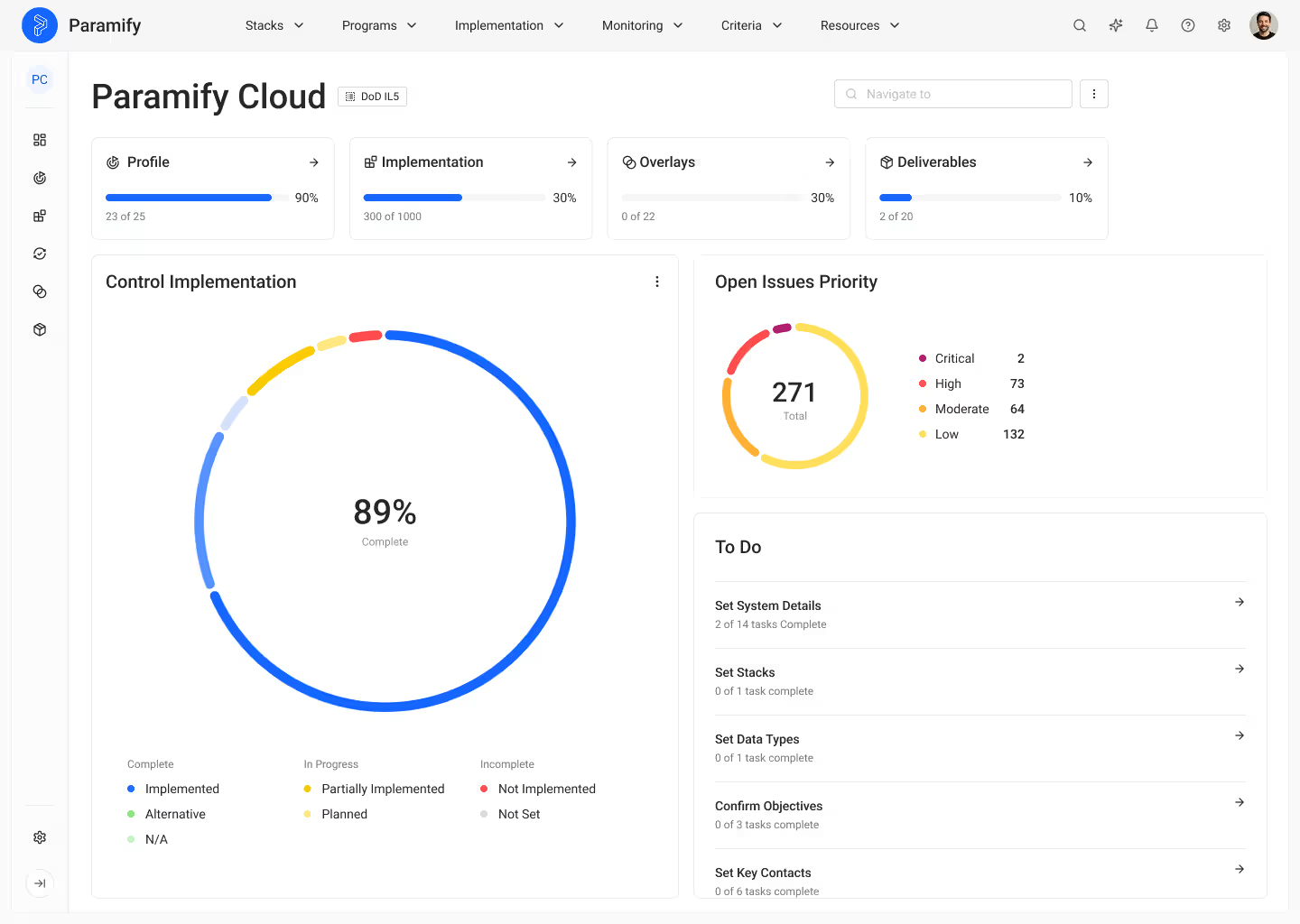
Paramify was built for exactly this. Instead of treating your SSP as a 1,200-page Word document that someone has to rewrite every time something changes, Paramify builds your documentation from your actual control implementations.
All documentation is generated automatically from a single source of truth that renders to FedRAMP-required formats and CC SRG overlays automatically.
How Paramify helps you reach FedRAMP and DoD IL ATOs faster
“Paramify is God’s gift to the compliance world. If you’re going for FedRAMP or DoD IL5, don’t waste your time. Just make the purchase and get it done.”
Manual FedRAMP is a documentation problem dressed up as a security problem. Paramify fixes the documentation problem.
If you’re pursuing FedRAMP and a DoD IL ATO, Paramify strips away months of effort from each authorization — and a much shorter delta between the two packages than you'd produce any other way.
Here's what that actually means for your roadmap:
- Your FedRAMP Class D (formerly High) SSP and your IL5 SSP are not two separate documents. They're two renderings of the same underlying control implementation, with the CC SRG overlay applied automatically. One data model, multiple packages.
- When you update a control, the change propagates across every package you maintain. No manual hunt-and-replace across multiple 2,000 page SSPs.
- Your Independent Assessor and AO reviewers get validated OSCAL artifacts they can ingest directly into their tooling — which means cleaner reviews, fewer findings, and shorter cycles.
- Continuous monitoring and POA&M tracking. Not a spreadsheet. Not a separate spreadsheet for each framework.
If you're starting your authorization journey or stuck mid-package, talk to our team or schedule a demo to see where Paramify can take pressure off your roadmap.
Learn more:
→ Are you ready for FedRAMP? Get your FedRAMP Readiness Checklist.
→ How to automate FedRAMP & DoD IL planning, implementation strategy, and documentation.
→ What’s an SSP and the easiest way to build one
Frequently asked questions
Is a FedRAMP ATO the same as a DoD IL ATO?
No. A FedRAMP ATO authorizes a cloud service for federal civilian use under NIST SP 800-53 baselines. A DoD IL ATO authorizes that same service for DoD-specific use under the DISA Cloud Computing Security Requirements Guide. They share most controls but have different sponsors, different overlays, and different deployment requirements.
Do I need a FedRAMP ATO before I can get a DoD IL ATO?
Technically no, but in practice yes. The DoD CC SRG uses FedRAMP baselines (Class B/Moderate for IL2/IL4, High for IL5/IL6) as its starting point, and Mission Owners almost always expect a FedRAMP package before sponsoring a DoD IL ATO. The fastest path to IL4 or IL5 is to earn FedRAMP Class D/High first and then layer the DoD overlay.
What is the difference between FedRAMP High and DoD IL5?
FedRAMP Class D (formerly High) and DoD IL5 share the same NIST SP 800-53 baseline (about 410 controls). IL5 adds a National Security Systems overlay, requires dedicated multi-tenant infrastructure physically separated from non-federal systems, mandates U.S. Persons in privileged roles with ADP-2 / NACLC clearances, and connects through DISA's NIPRNet via a Cloud Access Point. FedRAMP Class D is reusable across federal civilian agencies; IL5 ATOs are issued by a specific DoD Mission Owner.
What happened to DoD IL3?
DoD IL3 was retired during a consolidation of the CC SRG. The current levels are IL2, IL4, IL5, and IL6.
What is FedRAMP+?
FedRAMP+ is an informal term for the combination of a FedRAMP High baseline plus the DoD CC SRG overlays needed to reach an Impact Level. It is not a separate program — it is how reciprocity between FedRAMP and the CC SRG actually works in practice.
How long does a DoD IL ATO take?
Plan for 6 to 18 months on top of an existing FedRAMP authorization, depending on the Impact Level and the Mission Owner's review cadence. IL4 is the fastest; IL6 is the longest because of the hosting and personnel requirements.
How much does a FedRAMP ATO or DoD IL ATO cost?
A FedRAMP High authorization typically costs $500K to $3M when you account for Independent Assessor fees, internal staff time, remediation, and documentation. A DoD IL ATO on top of FedRAMP usually adds $250K to $1.5M. Costs scale with the size of your system, the maturity of your control documentation, and the number of inherited controls from your CSP.
Can a FedRAMP ATO be reused by another agency?
Yes. That is one of the main benefits of FedRAMP. Once a cloud service offering is authorized by one agency (or by the FedRAMP Board), other agencies can issue their own ATO against the same package without re-running the assessment.
Can a DoD IL ATO be reused across DoD components?
It depends. The Mission Owner's ATO is specific to the system and use case they authorized. The underlying CSP's DISA Provisional Authorization is reusable across the DoD by other Mission Owners. So an ISV with an IL5 ATO from one Mission Owner usually has an easier path to a second Mission Owner inside the DoD, but it isn't automatic.
Do I need a DoD Mission Owner to start?
Yes — to actually get the ATO. You can start FedRAMP work, build to FedRAMP Class D (formerly High), and map the CC SRG overlay without one, but a Mission Owner has to sponsor the DoD IL ATO decision itself.
Where does OSCAL fit in?
OSCAL is NIST's structured language for security controls, assessments, and authorization packages. Machine-readable OSCAL documentation speeds up your reviews. Paramify automatically produces OSCAL and human-readable documentation.
.avif)
.svg)
.svg)