In This Article
Watch the video: Paramify vs AI
Can AI run your security program instead of a GRC platform?
If ChatGPT or Claude can write a control narrative in seconds, what's the value of paying for compliance software at all?
These are fair questions. AI subscriptions are cheap, the output reads well, and it's hard to tell where the tools stop being useful and start being a risk.
The answer comes down to one distinction: AI is probabilistic, and a system of record is deterministic. Here we'll break it down so you know
- What that means for your compliance
- What AI does well in a GRC program
- Where it falls short
- How to use AI to build evidence you can stand behind
Probabilistic vs. Deterministic AI: What It Means for Compliance Evidence
Think of Plinko. You drop a ball at the top, it bounces down a board of pegs, and it lands in one of the slots at the bottom.
You can try to predict where it'll fall based on where you drop it, and you might give it a little push or spin to influence where it lands. But you have no way of knowing exactly which slot it'll land in.
Drop five balls from the same exact spot with the same exact drop, and they might end up in different slots.
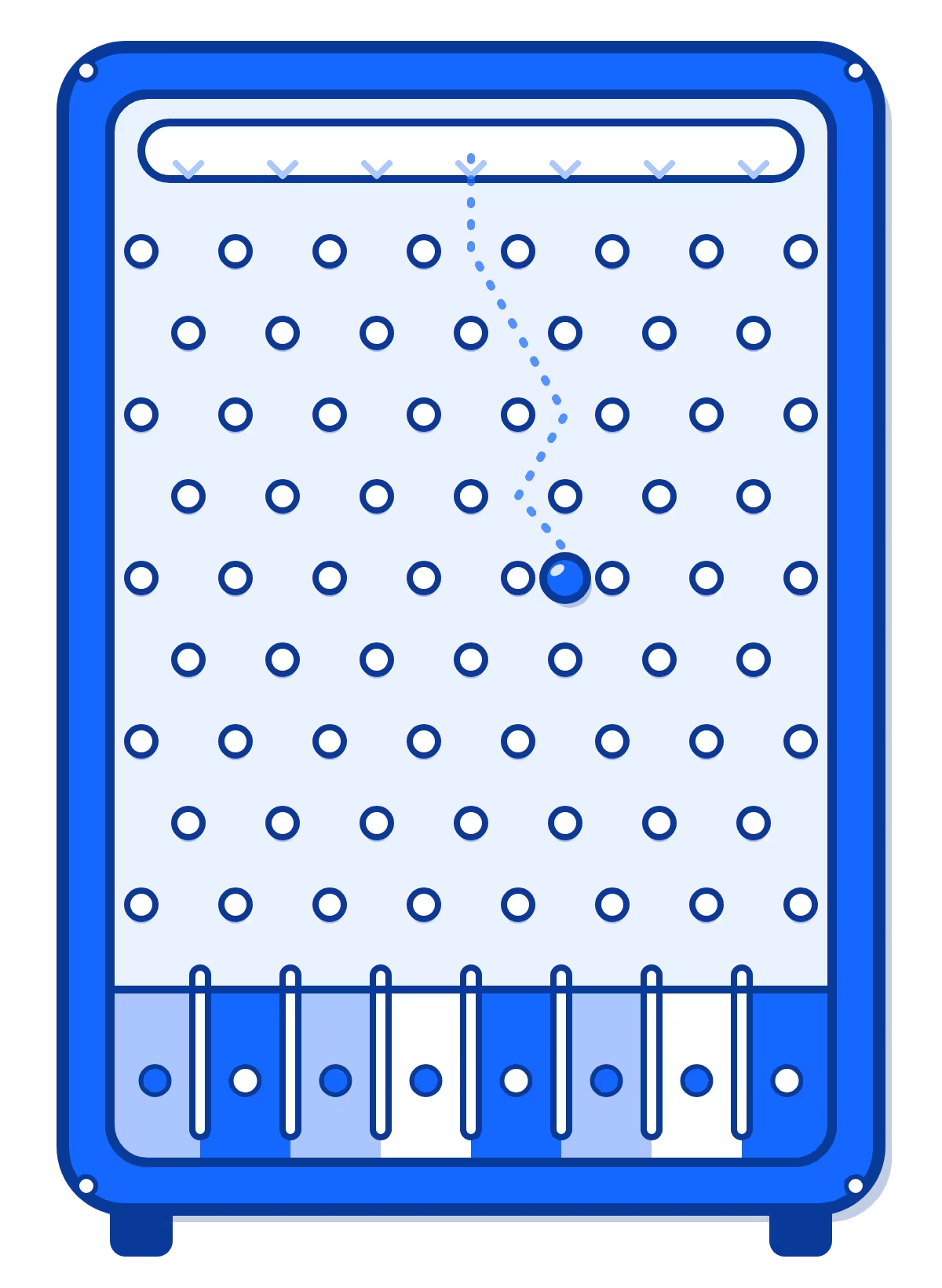
AI works the same way. A model has weights that influence how the input, the prompt that comes in, turns into the output that comes out. The model, the data you give it, the harness and the prompt all shape the result.
A similar prompt with similar data will very likely produce a similar output, but not an identical one.
You can test this in ChatGPT: give it the same prompt five times and you'll get a similar response that's slightly different each time.
Like a ball on a Plinko board, AI takes a different path each time because it's probabilistic.
NIST's Generative AI Profile (NIST AI 600-1) names a related risk, confabulation, where generative AI systems produce false or erroneous content and present it confidently.
That's a problem when the content is a statement about your security controls.
A script is different. A bash script or other coded program that takes certain inputs and returns a certain output is deterministic, as long as you don't introduce an element of randomness.
Every time you give it the same input set, you get the same output. That keeps you more accurate and more accountable for the results.
What AI Is Good At in a GRC Program
AI earns its place in a compliance program for work where a fluent, fast draft is the goal and a person checks the result.
Some tasks are a different story. AI can look very good at them: the response is confident and the output reads well. But the model doesn't always know the level of detail it needs to answer accurately, so it may jump to conclusions, make assumptions from the evidence it's given and miss how your systems are interconnected.
The bigger limit: AI usually can't check whether a statement is true for your actual system unless you've given it some kind of read access to those system components.
Where AI Falls Short: Proving a Control Is Actually Implemented
Here's a good example of where AI does well and where it falls short. Ask ChatGPT, Claude, or whatever AI you use to write an MFA control narrative.
It will likely produce a confident, specific paragraph about how multi-factor authentication is configured. But it likely doesn't understand the specific tools and settings you've configured, so it lacks the assurance that comes from connecting to the actual systems and seeing how they function.
That right there is the gap.
AI falls short at giving you a living record, or real assurance, of how a control is implemented. For that, you need a connection to the source system, or evidence from it, that verifies the state is true.
Some AI tools can be connected this way, but most aren't. And even when they are, they can provide some level of assurance, but the probabilistic nature of AI means they likely won't reach the level of assurance and accuracy a GRC program needs.
How to Use AI to Build Compliance Evidence You Can Trust
Where AI does shine is in creating the process you use to collect evidence, the proof of how a system is actually running. Here at Paramify, we've started building small scripts that validate specific controls.
Take a control like "MFA is enforced by Okta."
AI can generate the control narrative, and that's fine. What we really want is continual assurance that multi-factor authentication is actually configured in our Okta identity provider.
AI helps get us there in a few steps, using the Okta Policy API documentation as its source:
AI is effective at both ends: creating the script that gathers the evidence and reviewing the evidence once it comes in.
The script in the middle is what makes the process deterministic. It's repeatable and dependable, and it gives you a higher level of assurance than an AI summary alone.
Paramify's evidence fetchers follow the same idea: lightweight scripts that pull configuration data from a resource, stage it as JSON and send it to Paramify for validation.
This also lines up with where FedRAMP is heading. Under FedRAMP 20x, Key Security Indicators are meant to show that protections are working in your live environment on an ongoing basis, which is hard to do with narratives alone. See what FedRAMP 20x actually requires for the details.
AI can be an enablement in many ways, but accountability stays with you.
Can AI Replace GRC Software? AI Alone vs. AI With Paramify
AI can't replace a system of record, but it works well layered on top of one. Here's how the two approaches compare side by side.
A few of these deserve more detail.
On outputs, FedRAMP publishes its own OSCAL templates and validation rules, and an AI-generated SSP or POA&M has no built-in way to know whether it conforms.
With Paramify, you don't have to worry about whether the output fits the FedRAMP schema, and the data behind it comes from a system of record. That's the core of why manually writing SSPs is outdated and why OSCAL needs structured data behind it to work well.
On evidence, reuse is what cuts the work year over year. Paramify runs on a single data model of your people, systems and controls, so work done for one framework carries over to the next instead of being rebuilt for each audit. That data model, the ontology in Paramify, is also the foundation of Paramify's approach to AI.
On cost, anyone who's done a project with AI vibe coding has learned how much maintenance comes with it, especially once multiple people start contributing. Someone has to update versions, update packages and track all the little specifics. Paramify is built to carry that complexity as you add users and frameworks, including the path to FedRAMP 20x certification.
That's the value of a deterministic platform with AI layered on top. AI replaces manual processes, summarizes, does first passes and finds inconsistencies in the results. Paramify is the deterministic system of record it all runs from.
Using AI in Compliance Without Losing Accountability
AI can't run your security program on its own, because it's probabilistic and your security package has to be accurate.
It's still useful: it explains controls, summarizes guidance, drafts first passes and writes the scripts that collect evidence from your systems.
The difference is where the truth lives. When evidence comes from the source system and sits in a deterministic system of record, AI speeds up the work without putting your package at risk. If you want to see how Paramify gives AI that foundation, or you have questions about your own program, reach out or request a demo below.
Read more
- What Does Paramify Do?
- How Paramify Automates Evidence Collection, Validation, and Issue Creation
- What Does FedRAMP 20x Actually Require?
- The Benefits and Shortcomings of OSCAL
- Building Continuous Assurance: How CDW Rebuilt Its Compliance Program with Paramify
- Ontology Is the Foundation of Paramify's Approach to AI
FAQ
Can AI replace GRC software?
No. AI is probabilistic, so the same prompt can return a different answer each time. A GRC program needs a deterministic system of record with evidence verified at the source. AI works best layered on top of that system.
What is AI good at in compliance work?
Explaining a control or framework in plain English, summarizing long guidance and drafting a first pass at a policy or control implementation statement. It's also effective at writing scripts that gather evidence and reviewing that evidence once it comes in.
Why can't I just use an AI-written control narrative?
An AI-written narrative reads confidently, but the model likely doesn't know the specific tools and settings you've configured. Unless it's connected to your systems, it can't verify the statement is true.
What does deterministic mean for compliance evidence?
A deterministic process returns the same output every time it gets the same input. A script that pulls MFA settings with a read-only API key is repeatable and dependable, which gives you higher assurance than an AI summary.
Can AI generate an SSP or POA&M for FedRAMP?
It can produce the text, JSON or spreadsheet, but the output may not validate against FedRAMP schema or match your actual system. Paramify builds and validates outputs against FedRAMP formats using data from a system of record.
Is a cheap AI subscription less expensive than a GRC platform?
The subscription is cheap, but the real cost is the staff time to build, refine and maintain AI processes, especially as more people contribute. A platform like Paramify is built to handle more users and frameworks without that upkeep.