In This Article
Watch : Kenny and Mike explain what you need to look for in your VDR tool
Is there a tool that will handle FedRAMP VDR for you out of the box? That's the question a lot of security teams are asking as the FedRAMP VDR and VER rules become required on December 7, 2026.
It's a lot of change on a short timeline, and most of the tooling is still catching up.
Here's a realistic look at what your scanner can and can't tell you, why scanner risk levels aren't PAIN levels, and how to evaluate vulnerabilities stack by stack so you can pick a VDR tool that actually fits.
Why can't one tool solve FedRAMP VDR out of the box?
Everybody wants a tool. Most teams already have their security tools in place, with scanners running and gathering all the info.
But what's hard to find is the tools to take that data and do VDR.
After all, the GRC tools found out about VDR and VER at the same time as everybody else. This means we're all still building a way to handle the whole process start to finish.
What Paramify is seeing in the market is people refactoring their approach to security right before our eyes.
The bottom line:
What changed with FedRAMP VDR and VER, and what didn't
PAIN levels were new to Paramify too. But the new standards were mostly a mapping exercise.
Paramify has always asked, "what's the risk?" PAIN adds a second layer: you have the risk of the vulnerability itself, and then the context of where that vulnerability is.
So did PAIN change Paramify's approach? Not really.
With Paramify, you have risks, risks have solutions, capabilities are the solutions you need to implement, and then you continuously validate them.
VDR covers one of the risks facing your organization: the vulnerabilities on your systems.
The question is how important those vulnerabilities are.
But, you're not going to get that from a tool."
You need a good answer for what components you're using, how often they're running, and a lot more.
One of the main questions we hear in the compliance space is "How are you thinking about PAIN levels?" It's still the very beginning of a whole new process.
Because Paramify takes a first principles approach to risk management, new requirements like this are a reporting problem, not a change in approach. And that's how Paramify's VDR tool is being built: from first principles, so it can handle LEV, PAIN, KEV and whatever else comes next.
The timeline is tight. FedRAMP moved mandatory adoption of VDR and VER to December 7, 2026 (with a grace period ending in March) to align with CISA BOD 26-04.
Failure to adopt VDR puts your FedRAMP status at risk. Read more here about what happens if you miss the deadline.
What your vulnerability scanner tells you for VDR
Start with your scanner. Tools like Wiz, Tenable, Rapid7 and plenty of others.
Your tool then scans everything in your environment. It has the targets, it finds the vulnerabilities on your systems, and it does it well and fast.
It also tells you whether a particular vulnerability is internet reachable. So a tool can tell you that a vulnerability is not only high risk, it's also internet reachable, which increases the PAIN level.
FedRAMP defines this broadly. The VER rules look at internet-reachable vulnerabilities, not just internet-accessible ones: any service that might receive a payload from the internet counts if a vulnerability can be triggered by processing it (VER-EVA-EIR).
Scanner risk levels vs. FedRAMP PAIN levels
One thing that surprises people, is that a risk level isn't necessarily a PAIN level. So the risk level that comes out of the box from your tool is just one factor.
A critical finding starts with a max PAIN level of two, which is a low PAIN level, with 192 days to fix at Class C.
From there, you need to know where that vulnerability is and how important the asset is. Does the asset hold critical information, or does it give someone a foothold to get to an asset that does?
None of that context comes from a tool that magically knows everything.
FedRAMP's rules point the same way. Providers must assign every vulnerability a Potential Agency Impact N-rating (PAIN) from N0 to N5 "considering the context of the cloud service offering" (VER-EVA-EPA).
The first evaluation factor FedRAMP lists is criticality: how important are the systems or information the vulnerability might affect?
That rating, plus likely exploitability and internet reachability, sets how long you have to act.
Here are the Class C timeframes from the FedRAMP 20x Class C VDR ruleset:
How to evaluate vulnerabilities stack by stack
Because context matters this much, Paramify's intake process goes stack by stack.
A stack is any group of people, processes, and technology working together to achieve some sort of mission.
There's the overall mission of your organization, and there are back-office stacks that are part of that mission. (Hopefully they're doing something to improve the bottom line.)
Organizing things this way at the very beginning tells you what people are doing for compute, cloud storage and database, and what mechanisms they use to protect those assets.
Sometimes assets are shared across the organization, and that's another vector to think about. A vulnerability on one internet-facing asset may not just affect one small stack. It can affect all the other stacks that share that asset, and it might affect agencies too.
This is modern security package management: telemetry about all the people, processes and technology in your organization that helps you make good decisions about where to spend your resources.
How Paramify automates PAIN ratings and VDR reporting
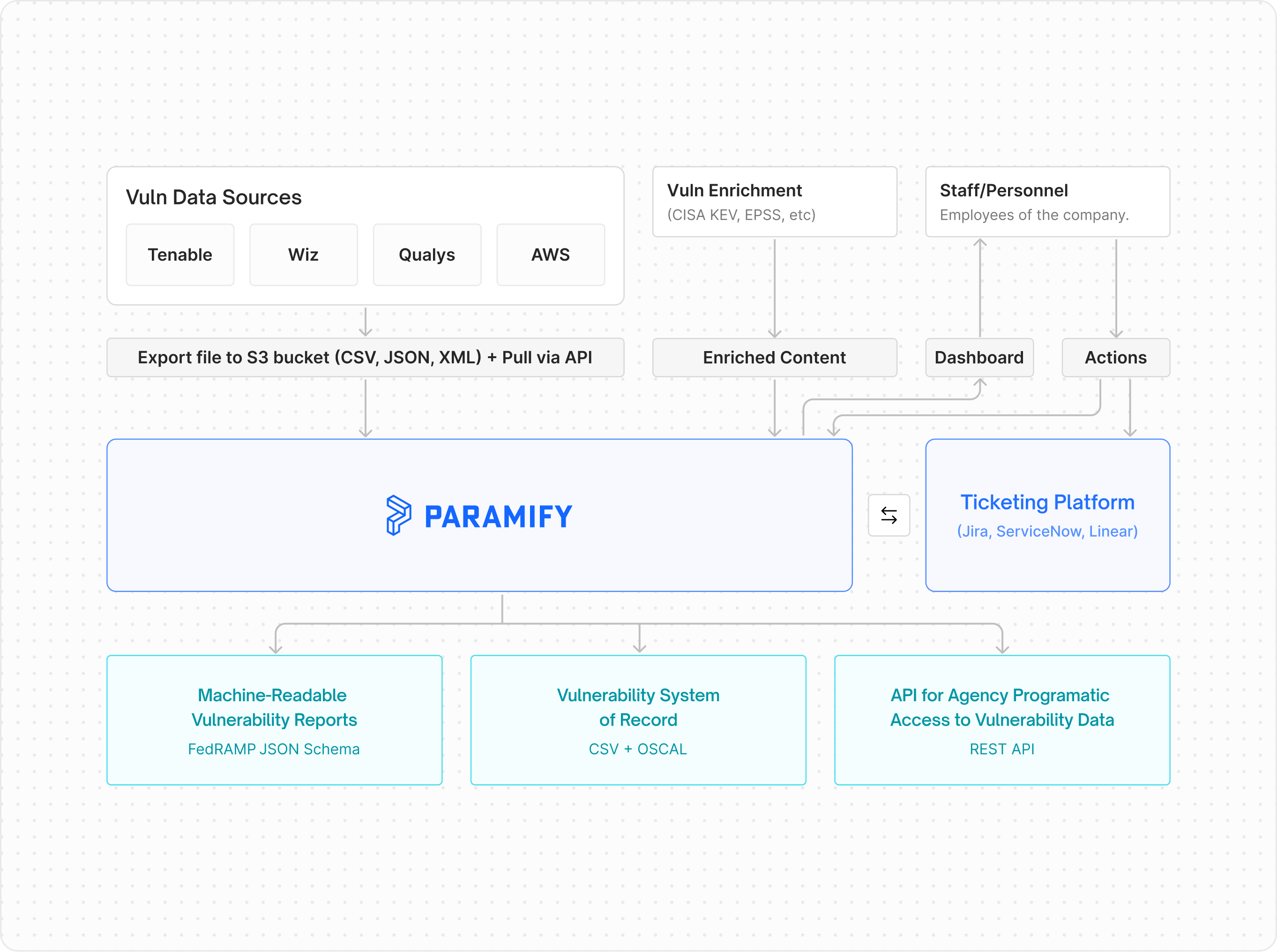
Paramify starts with intake, stack by stack. Once it knows your people, processes and technology, it pulls in scan data from Wiz, Tenable, Rapid7 or whatever you're using, and does the evaluation and reporting work your scanner can't:
- Rate PAIN from asset context. Every vulnerability gets an N0 to N5 rating based on the context of the asset it sits on.
- Factor in exploitability and reachability. Classify findings as likely exploitable or not and internet reachable or not, using FedRAMP default rules you can customize.
- Calculate every fix deadline. Due dates come from each finding's ratings, and anything due soon or overdue gets flagged.
- Build the reports agencies need. Schema-validated JSON and human-readable reports replace the monthly spreadsheet, and agencies can pull the data through an API.
Paramify's VDR and VER compliance works by connecting risks to solutions whose capabilities are continuously validated. VDR and VER become another set of reports from the same data model, alongside the rest of your CR26 deliverables and your FedRAMP 20x package. If you want the bigger picture, here's what Paramify does.
Should you rebuild your FedRAMP program from first principles?
A lot of teams are having to refactor how they do everything to fit this new world.
Most people at FedRAMP-certified companies didn't design their program from scratch. They inherited it, made improvements, and patched things on.
That makes now a good time to step back and ask how to take what you built for security and put a compliance program alongside it that's built for the future: one that stays flexible, grows with you, and can handle VDR, VER and whatever comes next.
Obviously, we're partial to Paramify's method, but the adjustment has to happen one way or another. We suggest taking the time to go redesign and approach it from a first principles approach.
Choosing a VDR tool that fits how you manage risk
No tool will hand you PAIN ratings out of the box, because PAIN depends on context only your organization has: which assets matter, what they protect, and who else shares them.
Your scanner is still essential. It finds vulnerabilities fast and can tell you what's internet reachable. The tool you add on top should take that data, apply your asset context stack by stack, and turn it into deadlines and reports.
That's what Paramify was built to do. If you have questions about VDR, VER or PAIN levels, contact Paramify or request a demo below.
FAQ
Can a vulnerability scanner handle FedRAMP VDR on its own? No. Scanners like Wiz, Tenable and Rapid7 find vulnerabilities fast, and some flag internet reachability. PAIN ratings also need asset context, like how important the asset is and who it affects.
What is a FedRAMP PAIN level? PAIN stands for Potential Agency Impact N-rating. It runs from N0 to N5 and estimates how much harm exploiting a vulnerability could do to agencies that use your service.
Is my scanner's critical rating the same as a PAIN level? No. The risk level from your scanner is one factor. PAIN also depends on where the vulnerability is and how important that asset is.
When do FedRAMP VDR and VER become required? December 7, 2026. Certified providers who aren't following the rules by March 7, 2027, when the grace period ends, lose certification until they are.
What is a stack? A stack is any group of people, processes and technology working together to achieve some sort of mission. Paramify evaluates risk stack by stack.
How does Paramify help with VDR and VER? Paramify pulls in your scan data, rates PAIN from asset context, factors in exploitability and reachability, calculates fix deadlines, and builds the reports FedRAMP and agencies need.
Read more
- What Are FedRAMP VDR and VER? The Difference, the Deadline, and the PAIN Scale
- What Happens If You Miss the December 7 FedRAMP VDR Deadline? The Grace Period, Explained
- How FedRAMP VDR Maps to RA-5 and SI-2 (and What Replaces Monthly ConMon Scans)
- Understanding BOD 26-04 and FedRAMP VDR: What You Need to Do to Stay Compliant
- Modern Security Package Management: Paramify's Approach
- Which CR26 Deliverables Does Paramify Automate?