
In This Article
Government contracts are worth the pain, we get it. But, it's easy for a FedRAMP project to stall out, blow through the budget, miss its deadlines, or fail outright. Too many CSPs jump in without knowing what's actually waiting for them.
We've helped most of the companies currently on the FedRAMP marketplace earn their Certification — plus dozens more working through other NIST 800-53 frameworks like DoD ATO, FISMA, and CMMC.
Across all of it, the same 7 FedRAMP Certification pain points show up again and again. Here's what they are, why they hurt, and how Paramify fixes each one so you can avoid the pitfalls that can wreck your FedRAMP process.
NIST 800-53 Pain Points and Paramify's Solutions at a Glance:
SSP creation & maintenance
Months of manual Word doc work that goes stale the moment it's done
Auto-generates an audit-ready SSP from your control implementations — always current, no Word doc surgery
Disconnected vulnerability tracking
Findings from pen tests, scans, and audits scattered across spreadsheets and email threads
Centralizes findings as structured issues tied to affected controls; ingests scan data automatically
Manual POA&M management
Error-prone spreadsheets with strict formatting requirements that drain GRC teams every month
Auto-generates POA&M output from tracked issues — consistently formatted and always submission-ready
Annual assessment chaos
Evidence hunting across a dozen systems under deadline pressure; assessors waiting on slow email chains
Centralizes evidence so assessors get direct access — less back-and-forth, shorter assessment cycles
Monthly ConMon fire drill
Packaging and uploading stale snapshots every month — data is already outdated by upload day
Maintains ConMon deliverables continuously — what agencies see always reflects your live posture
Control implementation tracking
Ownership, status, and CSP inheritance across hundreds of controls — spreadsheets can't handle it
Structures ownership, status, and inheritance natively via Solution Capabilities — the platform is the record
Duplicating work across frameworks
Separate documentation efforts for FedRAMP, SOC 2, CMMC, DoD IL — same controls documented four times
Maps one set of security capabilities across multiple frameworks simultaneously — document once, comply everywhere
1 - FedRAMP Documentation
The problem: The Insane Time, Cost, and Effort to Create and Maintain an SSP
FedRAMP teams can spend months building a System Security Plan in Word. 1,500+ pages. Hundreds of controls. Inheritance language copy-pasted from templates that may or may not still be accurate.
Then your system changes. Or the next assessment cycle comes around. And you do it all over again, copy-pasting until your fingers bleed, hoping the right sections get updated.
Before you know it you’re heading toward audit with a hope and a prayer that you got it all correct.
But, by the time the SSP is "done," it's already drifted from reality. The gap between what the document says and what the system actually does ends up costing you time and money when your audit findings show up.
Automated, Accurate Documentation
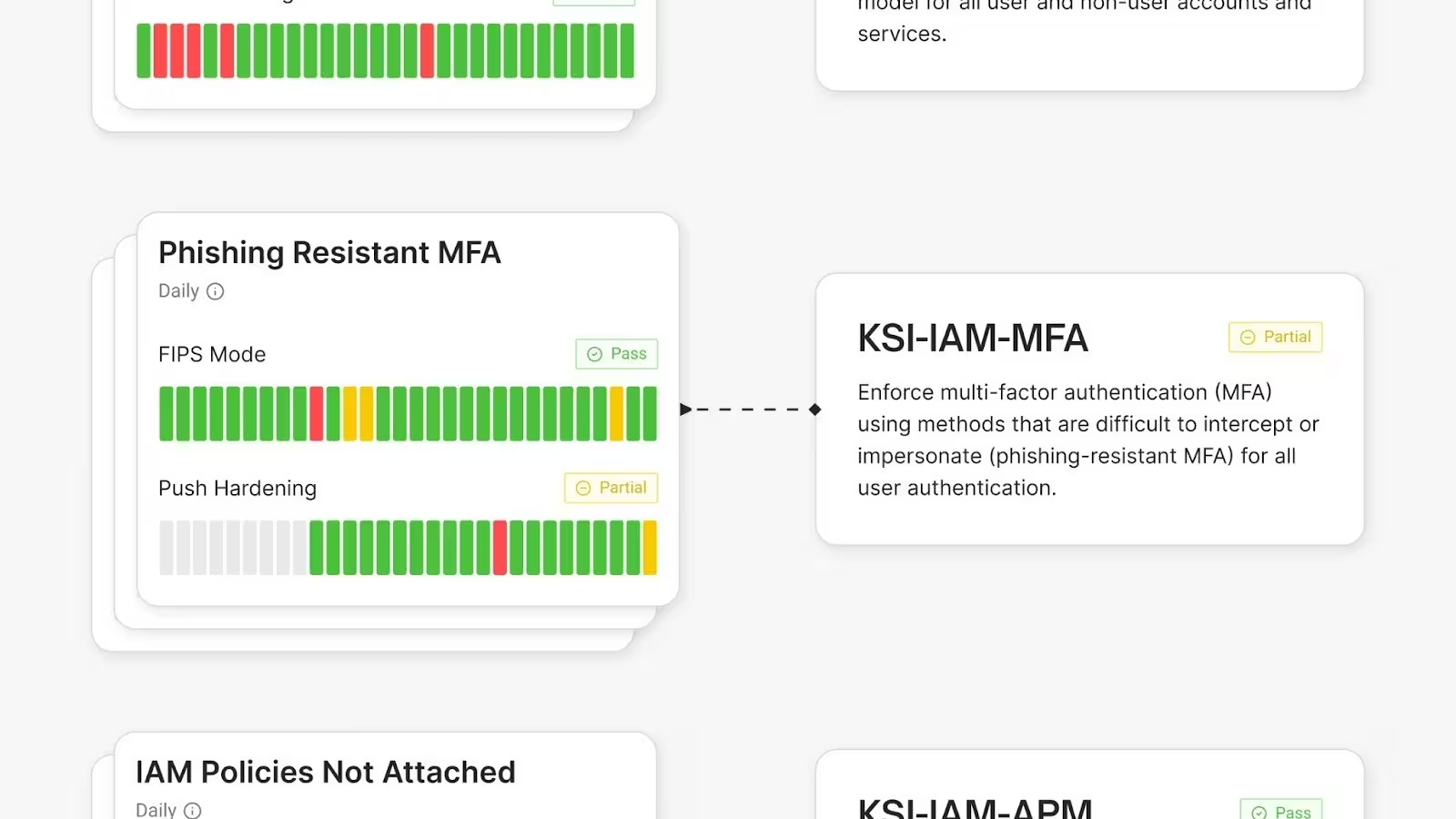
Paramify generates a continuously maintained, audit-ready SSP directly from your control implementations.
In less than an hour you can complete a gap assessment, or ingest your previous SSP to get a fully-automated SSP. Within 1-7 days, you can have your fully audit-ready documentation that's easy to update and maintain.
From there, when something changes in your environment, the SSP reflects it — no Word doc surgery, no version-control panic before an assessor visit.
The document is always current because it's always generated from the source of truth, not the other way around.
→ Learn more about Paramify's SSP automation or read case studies of businesses that have cut out 90% of their documentation headache with Paramify.
2 - Vulnerability Tracking
The problem: Disconnected Weakness, Deficiency, and Vulnerability Tracking Across Sources
Vulnerabilities fall through the cracks. They always do. Then they show up at the worst possible time, like right before submission.
Findings come in from everywhere:
- Pen tests
- Annual assessments
- Vulnerability scans
- Internal audits
- Bug bounty submissions
- etc
These findings land in giant spreadsheets named POA&M_v3_FINAL_REAL_v2.xlsx and email threads nobody can find a month later.
→Learn more: The problem with manual vulnerability management
Centralized Vulnerability Tracking
Paramify centralizes vulnerability tracking through structured issues tied directly to the affected controls. Vulnerability scan data flows in automatically. Nothing has to be retyped, reformatted, or remembered.
Your POA&M reflects the actual state of your security findings instead of the state from three weeks ago when someone last had time to update the spreadsheet.
3 - POA&M Management
The problem: Losing Time With Manual POA&M Management
The formal POA&M has strict formatting, milestones, and reporting requirements that agencies scrutinize closely.
Producing it manually in the world’s largest spreadsheet is error-prone, to say the least. Monthly maintenance exhausts GRC teams or costs orgs oodles in consulting fees.
All of it can distract from time you could be spending on actual security work, instead of documentation.
Automated, Spreadsheet-free POA&Ms
- Paramify generates POA&M output automatically from the issues you're already tracking.
- The format is consistent and milestones are tracked alongside the underlying weaknesses.
- It's always submission-ready — because the data behind it is always current.
- You stop spending the week before submission cleaning up a spreadsheet. You spend it on actual security work.
→ Request a video demo to see the POA&M automation process with Paramify
4 - Annual Compliance Assessment Cycle
The problem: Content Chaos
Many businesses have fallen into the trap where coordinating an annual assessment traditionally means collecting evidence from a dozen different systems and a dozen different people, under deadline pressure, while everyone is also trying to do their actual jobs.
Screenshots go out of date. Evidence requests get lost. Assessors ask follow-up questions that take a week to answer because the person who has the answer is on vacation, in a meeting, or doesn't realize you're waiting.
Centralized Evidence Collection
Paramify centralizes compliance materials and evidence in one place.
Your Independent Assessor can be granted direct access to exactly what they need without long email chains, or Box folders shared at 11 PM the night before a meeting.
Less back-and-forth means a shorter assessment cycle and a less miserable Q3.
5 - Continuous Monitoring
The problem: Overwhelming Monthly Fire Drill
ConMon is supposed to be continuous. In practice, most orgs do ConMon monthly.
Every month, CSPs upload a snapshot of deliverables — POA&M, system inventory, vulnerability scan files — to a shared repository where agency customers review them.
Keeping those files accurate, formatted correctly, and uploaded on time every single month is its own ongoing burden.
And by the time the package is uploaded, the data inside is already a few weeks stale. Agencies are reviewing a snapshot of where you were, not where you are.
Automated Continuous Monitoring
Paramify maintains your ConMon deliverables continuously.
What agencies see in the repository always reflects your current posture — not what was accurate three weeks ago when someone had time to compile the package.
ConMon stops being a monthly event and starts being what the name implies.
6 - Implementation Tracking
The problem: Out of Control Tracking
Legacy Rev 5 requires you to precisely document what's implemented, who owns each control, what status it's in, and how inheritance from your underlying CSP (AWS, Azure, GCP) is handled.
And it requires you to do it across hundreds of controls.
With ownership that shifts whenever someone leaves, changes roles, or hands off a service.
Spreadsheets break down at this scale. They always have. Inheritance modeling, especially the part where you have to be precise about what your CSP gives you vs. what you implement on top, is where manual tracking turns into a mess fastest.
In-Platform Tracking
Paramify structures all of this natively through Solution Capabilities. Ownership, status, and inheritance modeling are built into the data model, not in a column in a spreadsheet you hope stays current.
The platform is the record. You're not maintaining a parallel record that has to be reconciled with reality every quarter.
7 - Endless Compliance Deliverables
The problem: Duplicating Work Across Frameworks
Most organizations pursuing FedRAMP aren't only pursuing FedRAMP. They need SOC 2 for commercial customers. CMMC if they touch the DoD supply chain. DoD IL4 or IL5 for deeper defense work. Even TX-RAMP or GovRAMP for state and local.
This has meant a separate documentation effort for each. The same control, implemented the same way, documented four different times in four different formats.
It's mind-numbing.
It's expensive.
And it's the kind of work that burns out compliance teams faster than anything else on this list.
Automated Documentation Across Projects and Frameworks
Paramify maps a single set of security capabilities across multiple frameworks at the same time.
Work you do for FedRAMP automatically satisfies overlapping requirements in CMMC, DoD ATO, SOC 2, NIST 800-171, etc.
You document once.
You comply everywhere the controls overlap.
The frameworks you add after FedRAMP cost a fraction of what they would have cost as parallel efforts.
What About FedRAMP 20x and the BIRs?
FedRAMP isn't standing still. The Balance Improvement Releases (BIRs) are pushing the program toward machine-readable authorization packages (OSCAL), formal Trust Centers with API access, and continuous data sharing with agencies instead of monthly file dumps.
Easy Machine-Readable OSCAL Package Generation
FedRAMP's Authorization Data Sharing BIR is currently optional, but encourages orgs to replace traditional Word document submissions with machine-readable authorization packages.
OSCAL is the main format for machine-readable documentation. Producing valid OSCAL manually requires specialized knowledge; the schema is complex and any structural error can invalidate the package.
Paramify auto generates OSCAL output directly from the compliance data already in the platform, keeping packages in sync with your implementation without any hand-crafting.
Trust Center / Public Compliance Transparency
This BIR also encourages guidelines for Trust Centers, the structured, permissioned repositories where CSPs store and share authorization data with agencies, including API access, access provisioning/logging, and machine-readable formats.
You can easily meet these requirements with Paramify. We provide a live, controlled, always-current view that replaces the manual process of packaging and distributing documentation on request every time an agency needs access.
Who Paramify Is For, and Who it Isn’t
A quick, honest note: Paramify is built for teams that are serious about modern, high-fidelity security documentation. Because we automate compliance across multiple major frameworks, our platform is incredibly powerful, but it requires a certain mindset.
Paramify is not a good fit if:
- Your team is fiercely old-school: If your people are deeply attached to manual spreadsheets, static Word documents, and the "we've always done it this way" mentality, the shift to a modern compliance approach will feel like pulling teeth.
- You aren't ready for automation: Automation requires a willingness to embrace new workflows. If your organization isn't ready to transition away from traditional, siloed engineering and compliance habits, the tool won't match your culture.
- Your team wants to speed-run compliance: Paramify helps you build excellent security much faster and for far less money. But, if you’re looking for a tool that helps you appear compliant without actually making changes to your security, we’re not the best option for you.
But Paramify is exactly who you need if:
You are ready to leave the old-school scramble behind.
If you want a platform that transforms compliance from a chaotic, manual fire drill into a streamlined, automated, and genuinely secure process, regardless of which major framework you are tackling, Paramify was built for you.
Get Started With Paramify to Succeed at FedRAMP
Legacy FedRAMP Rev 5 is hard by design. The framework is thorough, the documentation burden is real, and the compliance calendar never stops..
What changes is how much of your team's time disappears into spreadsheets, Word documents, and monthly fire drills that shouldn't exist in the modern age. Every pain point described here is solvable. Most of them are solved the same way: structure the data once, generate everything from it, and stop maintaining parallel records that drift apart the moment someone gets busy.
That's what Paramify does. It doesn't make FedRAMP easy. It makes the work you put in count for more, last longer, and extend across every other framework your customers require.
If your team is ready to move past the copy-paste era of compliance, schedule a live demo to see what a continuously maintained authorization package actually looks like in practice.
If you're still committed to POA&M_v3_FINAL_REAL_v2.xlsx, no hard feelings. It'll be there when you're ready.

.svg)
.svg)


%20the%20requirements%20and%20who%20needs%20it.webp)