In This Article
“SSDR” has been renamed to “SDR,” and “System Security Decision Record” is now “Security Decision Record.” Media on this page (images, graphics, or videos) may still show older terminology.
Kenny Scott and Mike Schreiner sit down with Bhanu Jagasia and Vincent Tham from BladeStack, a team that calls itself a "technology company first that specializes in compliance," to explain why the old way of doing FedRAMP is broken.
But, what does the new way actually look like?
And where does AI fit in (and where does it absolutely not)?
Let's get into it.
Transparent Evidence Collection Matters
Bhanu coined a phrase: the dark matter of data. It's the negative space. The things you don't know you're not capturing.
When your evidence collection is a black box, you can see what's in front of you, but you have no idea what's missing.
- What API calls are actually being made?
- How is the data being fetched?
- What's being left out entirely?
This is exactly why transparency in evidence automation matters so much. At Paramify, our scripts, fetchers, and validators are fully inspectable. You can see the how and the what behind every piece of compliance data.
BladeStack resonated with this approach immediately because they'd built their entire practice around the same principle: if you can't see how the evidence was collected, you can't trust it.
Why the Legacy FedRAMP Process Was Broken
As Kenny says it: the legacy FedRAMP process ruined lives.
Strong words? Sure.
But if you've lived through it, you're probably nodding right now.
Here's how it worked in the old world:
You'd spend months, sometimes years, producing an SSP that nobody could realistically consume. The spirit behind the document was fine: give authorizing officials enough information to make a risk decision.
But in practice? Authorizing officials never read the full SSP. They couldn't, because it's impossible to read every 1,500-page document and fully understand what's happening inside each system.
So instead, they'd spot-check. They'd jump to IA-5(1). They'd flip to AC-2. They'd find that the components listed in one section don't match what's in the diagram three hundred pages later, and suddenly scrutiny goes through the roof.
Even teams who knew their system was solid would get tripped up by a copy-paste error in a document that was never designed to be consumed at that scale.
The result was an entire industry built around hiring consultants, burning them out on documentation, and filing the finished product in a cabinet.
Useful for audit. Useless for actual security.
As Bhanu puts it: the goal should always be a useful package for the client, not something that sits locked away until the next assessment.
→ See how Paramify replaces manual documentation with automated, auditable compliance
FedRAMP 20x Changes Everything (Yes, Everything)
20x is where FedRAMP finally gets fun.
FedRAMP 20x replaces the old static-document model with real-time, automated evidence. Instead of the SSP, the future is the Security Decision Record (SDR), a living artifact where telemetry is built directly in.
Think about what that means in practice: With 20X, you can compare your SDR from May 31st to your SDR from June 1st and see exactly what changed. You can use AI to describe the differences between those snapshots, and because it's a single, bounded comparison, the results are highly accurate.
That's a fundamentally different use case than asking an LLM to generate a 1,500-page document from scratch.
Does 20x demand more from cloud service providers? Absolutely. More engineering investment, more tooling, more real-time infrastructure.
But the payoff is massive:
- Agencies finally get genuine assurance about the systems they're authorizing
- CSPs can maintain their certification posture continuously instead of through periodic, painful re-assessments
- Significant change requests become exponentially easier because you have a deterministic system of record to diff against.
And here's the part that doesn't get said enough: this model is coming for everything. SOC 2, ISO 27001, CMMC. 20x isn't just a FedRAMP initiative. It's the future of compliance, period.
→ Learn how Paramify is building for FedRAMP 20x
AI in Compliance: The Hype, the Reality, and the Math
Every compliance vendor, every conference talk, every pitch deck right now has the same question hovering over it:
"Can't I just use AI to do all of this?"
The answer is sometimes yes and sometimes no.
Here’s what AI is actually good at in compliance:
- Summarizing evidence
- Reformatting documentation
- Comparing snapshots (like SDR diffs)
- Accelerating human judgment calls
- Validation of correctness and format
What AI is not good at (yet):
- Making risk decisions autonomously
- Replacing domain expertise and contextual judgment
- Handling the "it depends" scenarios that define compliance advisory
- Deterministic accuracy across long, chained workflows
Here's the math that should keep you up at night. If your AI agent has a 5% failure rate (which sounds great, that's 95% accuracy) and you chain it across 100 iterations in a complex workflow, your cumulative success rate drops to roughly 0.6%.
Not 60%.
Zero-point-six percent.
That's why both BladeStack and Paramify advocate for a deterministic-first approach.
85 to 90% of your system should be reliable, inspectable code. AI handles one or two well-scoped tasks where its prediction capabilities actually shine. That's how you build something you can trust.
Should You "Vibe Code" Your Way to FedRAMP?
In short, no.
Think about this: None of the major AI companies have ever suggested they could vibe-code their own compliance.
Not OpenAI. Not Anthropic. Not xAI.
These are the companies building frontier AI models, and every single one of them is out there looking for platforms and expert advisors to help them get certified.
They know that prompting your way through FedRAMP doesn't work because they understand, better than anyone, what their technology actually is and isn't capable of.
So when someone tells you they're going to "prompt engineer" their way to an ATO... just smile and nod.
Security Expertise Is More Valuable Than Ever
Here's the counterintuitive takeaway you need to hear: the more AI commoditizes, the more your expertise matters.
AI is great at producing the average: Decent first drafts. Boilerplate. MVP dashboards. (Yup, everyone gets a dashboard now.)
But, the professionals who actually understand FedRAMP controls, who can make judgment calls about risk acceptance, who know how to architect compliant systems? Those people become the differentiator.
Prompt engineering alone doesn't compete with genuine domain expertise. You still need to think about authentication, data integrity, secrets management, database security, and all the architectural decisions that AI tools gloss over. The tech debt from AI-generated code is real, and somebody has to address it.
This is exactly why lean, expert teams with the right tooling punch above their weight class.
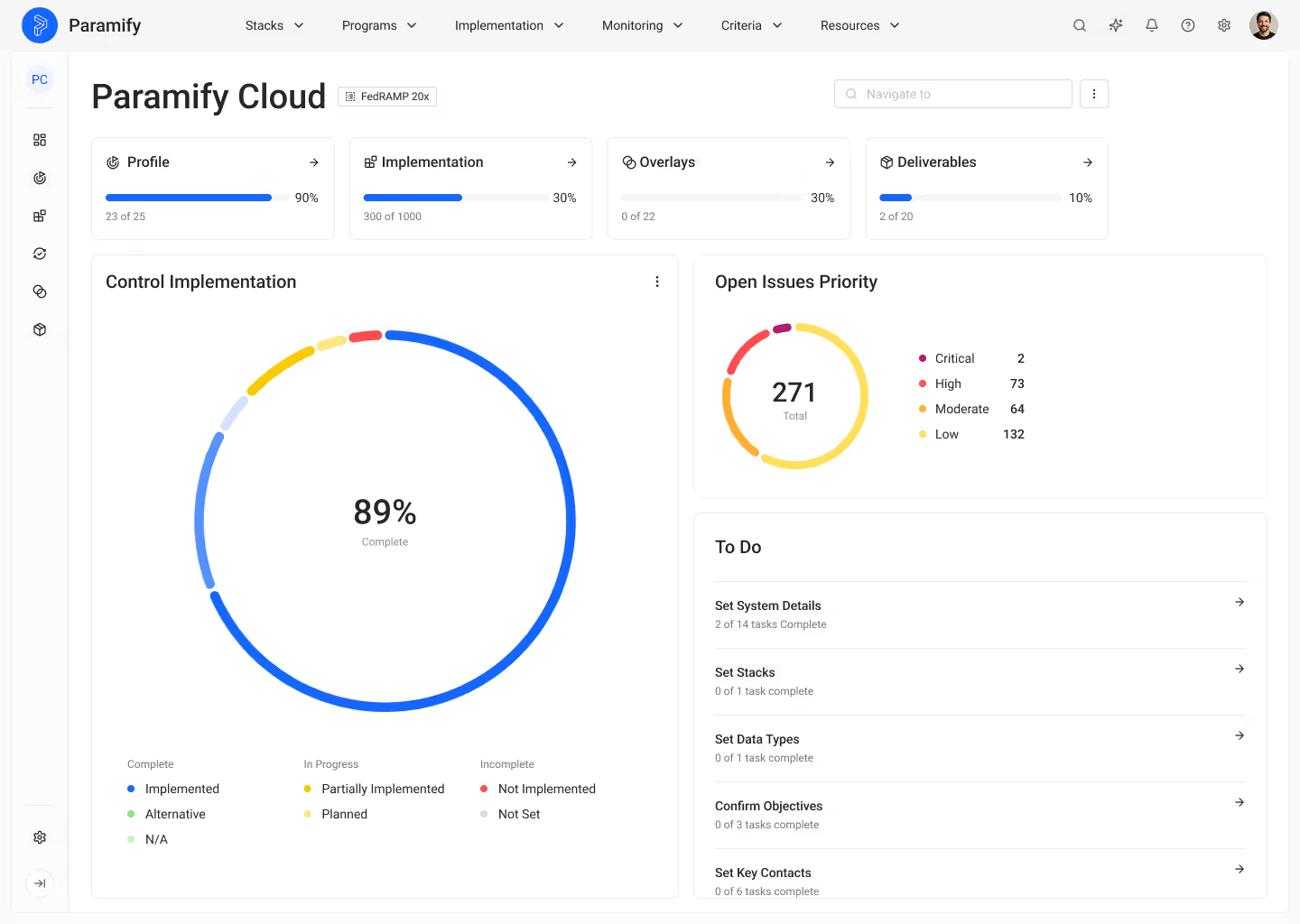
BladeStack brings deep FedRAMP advisory and engineering expertise. Paramify provides the platform for modern security package management.
Together, small teams can outperform the massive consulting operations that defined the old compliance world.
How to Do Vulnerability Management in the Modern Age
AI doesn't just change compliance. It changes the threats you're complying against.
The average time to exploit a vulnerability used to be measured in months. Now? AI-powered exploit tools are compressing that to less than a day.
When adversaries are moving at machine speed, you can't afford to sit behind static risk assessments to make security decisions. This means continuous monitoring, real-time evidence, and automated compliance validation are now survival requirements, not nice-to-haves.
And, it's exactly why FedRAMP 20x exists.
Sure, the old model was slower, but it was also architecturally incapable of keeping up with the modern threat landscape.
The new model, built on automated evidence and continuous certification, is the right response.
Build for the Future of FedRAMP
The old FedRAMP model asked you to build 1,500-page SSPs nobody could read, using evidence tooling nobody could inspect. The new model with transparent evidence, real-time artifacts, deterministic systems with AI in a supporting role, is how compliance keeps pace with threats moving at machine speed.
It's also how Paramify is built. Every script, fetcher, and validator is inspectable, and security comes first, with reporting automated as you go. Legacy package or FedRAMP 20x, the platform is ready.
Have questions about updating your security? Reach out any time with questions, learn more about what Paramify does, or request a personalized demo below to see why more companies on the FedRAMP Marketplace use Paramify than any other risk management platform.
See More of the Paramify Podcast
Catch the full conversation on the Paramify Podcast on YouTube, including BladeStack's cyberpunk samurai origin story, why pizza in South America is apparently terrible, and what will (and won't) happen by April 2027.
FAQ
What is the "dark matter of data" in compliance?
A term coined by Bhanu Jagasia of BladeStack to describe the negative space in your evidence collection, the things you don't know you're missing when your processes are opaque. Transparent evidence automation (like Paramify's inspectable scripts and fetchers) eliminates this blind spot.
Can AI replace FedRAMP compliance expertise?
No. AI is a powerful accelerator for specific tasks like summarizing evidence, comparing document snapshots, and formatting outputs. But compliance work requires contextual judgment, domain expertise, and deterministic accuracy that current AI models can't deliver autonomously.
The best approach is deterministic code for 85 to 90% of the workflow, with AI handling well-scoped tasks where it excels.
What is FedRAMP 20x?
FedRAMP 20x is the modernization initiative replacing static documentation (like the traditional SSP) with real-time, automated evidence through the Security Decision Record (SDR). It represents a fundamental shift from periodic, document-heavy assessments to continuous, telemetry-backed certification.
What is the Security Decision Record (SDR)?
The SDR is the successor to the traditional System Security Plan under FedRAMP 20x. Unlike the SSP, the SDR is a living document with telemetry built directly in, enabling real-time comparison of your security posture over time.
Is legacy FedRAMP going away?
The legacy process is being phased out in favor of the 20x model. Organizations should be investing in modern compliance tooling and automated evidence collection now. Paramify is built for this transition.

.svg)
.svg)